
I once worked with a company that had military-grade encryption on all their sensitive files. They spent a fortune on firewalls and intrusion detection systems. Yet, they suffered a major data breach not because of a sophisticated software exploit, but because an employee received a convincing email from someone posing as the CEO, asking for an "urgent" project file. The employee, wanting to be helpful, promptly sent it. This is the crux of the problem: technology can't patch human psychology.
Your most advanced security protocols mean very little if an attacker can simply ask for the keys. This manipulation is the core of social engineering, and it represents one of the most significant threats to your information today. It's not about hacking computers; it's about hacking people.
Table of Contents
What Exactly Is Social Engineering?
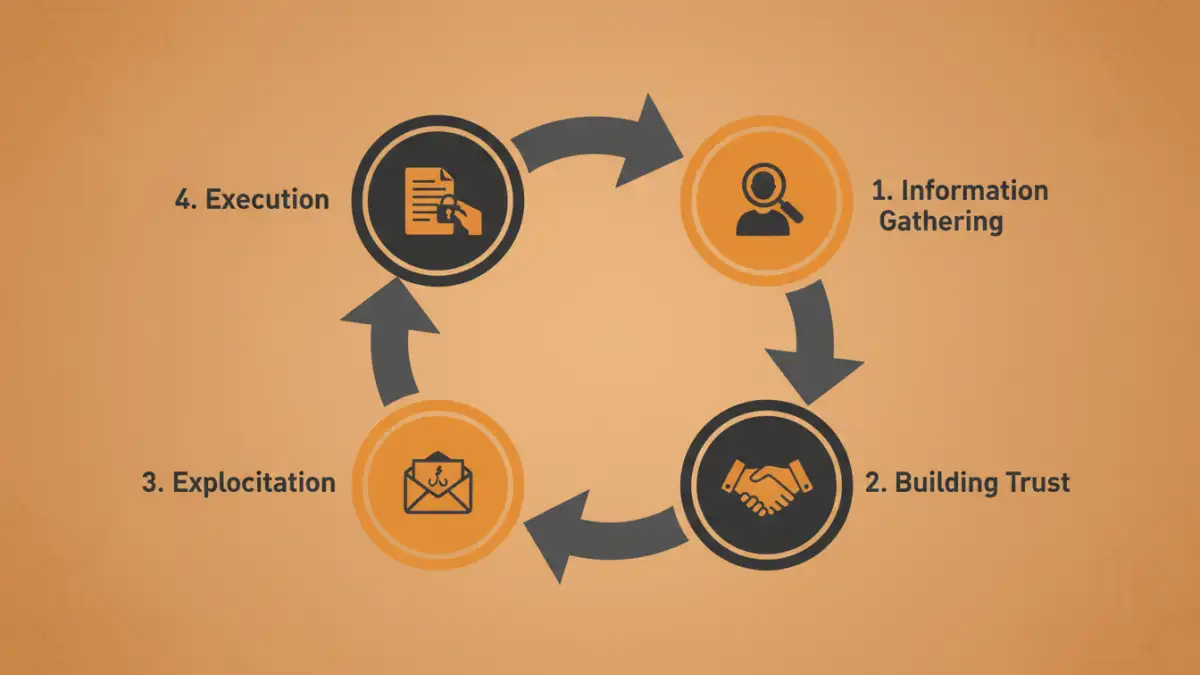
At its heart, social engineering is the art of psychological manipulation. Attackers use it to trick individuals into divulging confidential information or performing actions they shouldn't. Instead of trying to find a vulnerability in your software, they exploit predictable human traits like trust, fear, curiosity, and a desire to be helpful. It's a low-tech, high-impact method to bypass layers of expensive security infrastructure.
Think of it this way: why spend weeks trying to break down a reinforced steel door when you can just convince someone with a key to open it for you? That's the efficiency and danger of this approach. It targets the person, not the system.
Key Attack Vectors
Attackers have a well-established playbook. The most common tactics include:
- Phishing: Sending fraudulent emails that appear to be from legitimate sources to trick recipients into revealing sensitive data like passwords or clicking on malicious links. Spear phishing is a more targeted version aimed at a specific individual or organization.
- Pretexting: Creating a fabricated scenario, or pretext, to gain a victim's trust. An attacker might pose as an IT support technician, a vendor, or even a new employee to justify their request for information.
- Baiting: Luring victims with a false promise. This could be a free movie download or a USB drive labeled "Executive Salaries" left in a public area. Curiosity leads the victim to install malware, giving the attacker access.
- Vishing (Voice Phishing): Using the phone to conduct phishing attacks. Attackers often use caller ID spoofing to appear as if they're calling from a trusted number, like your bank or IT department.
The Human Element: Your Biggest Asset and Vulnerability
In any security system, the human is often the most unpredictable variable. We are wired to trust, especially when a request seems to come from an authority figure or is wrapped in a sense of urgency. This is precisely what makes the combination of document security social engineering so effective. An attacker doesn't need to break your document's AES-256 encryption if they can convince an authorized user to email them the decrypted file.
This is where technical controls fall short. A firewall can't detect a persuasive phone call. An antivirus program can't stop an employee from willingly entering their credentials into a fake login page. Security is not just a technology problem; it's a people problem. Recognizing this is the first step to building a more resilient defense.
Common Attack Scenarios Targeting Documents
To understand the threat, it helps to see how it plays out in the real world. These aren't theoretical exploits; I've seen variations of these happen to clients and colleagues.
The "Urgent CEO Request"
An employee in the finance department receives an email that appears to be from their CEO. The display name and email signature are perfect replicas. The email states the CEO is in a critical meeting and needs the latest quarterly financial report sent to a "consultant's" email address immediately for a potential acquisition. The urgency and authority pressure the employee to act quickly, bypassing normal procedures and sending the highly sensitive document to the attacker.
This attack works because it exploits the power dynamic and creates a time-sensitive crisis. The employee's desire to be responsive and helpful becomes the vector for the data breach. This is a classic example of how to prevent data theft by verifying unusual requests through a separate communication channel.
Building a Human Firewall to Protect Company Documents
Since the threat targets people, the solution must focus on empowering them. Creating a "human firewall" is about building a culture of security awareness where employees become the first line of defense, not the weakest link. This is achieved through consistent education and clear processes.
Effective human firewall training goes beyond a once-a-year presentation. It involves regular, engaging sessions that teach employees how to spot phishing attempts, the importance of verifying unusual requests, and who to contact when they suspect an attack. Simulated phishing campaigns are incredibly effective, as they give employees a safe environment to practice their skills and learn from mistakes. The goal is to instill a healthy sense of skepticism.
Furthermore, this training must be supported by clear, simple security policies. For instance, a policy stating that any request for sensitive data or wire transfers must be verified verbally or through a secondary channel can stop many attacks in their tracks. When people are trained and empowered, they can effectively protect company documents from even the most convincing social engineers.
Social Engineering Attack Vector Comparison
| Attack Vector | Description | Typical Medium | Prevention Strategy |
|---|---|---|---|
| Phishing | Broad, non-targeted fraudulent emails sent to many users. | Spam filters, employee training to spot fake links and sender addresses. | |
| Spear Phishing | Highly targeted emails aimed at a specific person or role. | Email, Social Media | Verify sender identity; question requests for sensitive information. |
| Vishing | Voice-based phishing, typically over the phone. | Phone Call | Never provide credentials over the phone; call back using an official number. |
| Pretexting | Creating a believable story or scenario to gain trust. | Email, Phone, In-Person | Verify identities and requests through established, official channels. |
| Baiting | Using a tempting offer (e.g., free software, a USB drive) to lure a victim. | Physical Media, Web Downloads | Prohibit use of unknown USB drives; only download from trusted sources. |