
We're increasingly relying on artificial intelligence to automate document security, from classifying sensitive information to detecting threats. On one project, we implemented an AI to flag suspicious access patterns to our company's shared drive. Initially, it seemed brilliant, catching things our manual reviews missed. But then we noticed a pattern: it was disproportionately flagging requests from our international teams, creating access delays and frustration. This wasn't a malicious algorithm; it was a biased one, trained on a dataset that didn't adequately represent global usage patterns.
This experience was a stark reminder that while AI offers powerful tools, it can also inherit and amplify human biases. If we aren't careful, the systems designed to protect our information can inadvertently create unfair barriers and even new security blind spots. Addressing this challenge is a critical next step in the evolution of digital security.
Table of Contents
The Role of AI in Modern Document Security
Artificial intelligence is no longer a futuristic concept in cybersecurity; it's a foundational component. AI algorithms analyze vast amounts of data to identify threats, classify documents, and manage access permissions with a speed and scale that is impossible for human teams to match. For instance, an AI can scan thousands of documents per minute to identify and tag Personally Identifiable Information (PII), ensuring compliance with regulations like GDPR.
These systems learn from historical data to predict future risks. An AI might learn that documents related to a merger and acquisition are highly sensitive and automatically restrict access to a pre-approved list of executives. This automation streamlines workflows and enhances security posture, but its effectiveness is entirely dependent on the quality and impartiality of the data it learns from.
Common AI Applications
In my work, I've seen AI deployed in several key areas of document security:
- Automated Data Classification: AI models read document content, context, and metadata to automatically assign sensitivity labels (e.g., Public, Internal, Confidential).
- Threat Detection: Algorithms monitor user behavior to detect anomalies, such as an employee suddenly downloading hundreds of files, which could indicate a data breach or insider threat.
- Intelligent Access Control: Dynamic systems that adjust permissions based on user role, location, device, and the sensitivity of the requested information.
Unmasking Bias in Automated Security

The problem of ai bias in security arises when an algorithm produces systematically prejudiced results due to erroneous assumptions in the machine learning process. This isn't about robots having opinions; it's about flawed data and models creating discriminatory outcomes. The AI flagging our international teams is a classic example of data skew, where the 'normal' baseline was too heavily weighted toward domestic user behavior.
Bias can creep in from multiple sources. It can come from the data used to train the model, the design of the algorithm itself, or the way humans interpret and act on the AI's outputs. A system trained primarily on documents written in formal American English might incorrectly flag documents with different dialects or grammatical structures as low-quality or even malicious.
Sources and Consequences of Bias
The consequences of unchecked bias are severe. It can lead to unfair denial of access for legitimate users, creating productivity bottlenecks and frustration. More dangerously, it can create a false sense of security. If an AI is biased to look for specific types of threats, it may develop blind spots to novel or unexpected attack vectors that don't fit its prejudiced model, leaving the entire system vulnerable.
For example, an AI trained to spot phishing attacks based on known examples might miss a sophisticated, novel attack that uses different language or tactics. This is why diversity in training data isn't just an ethical imperative; it's a security necessity.
Strategies for Building Fair Access Control Systems
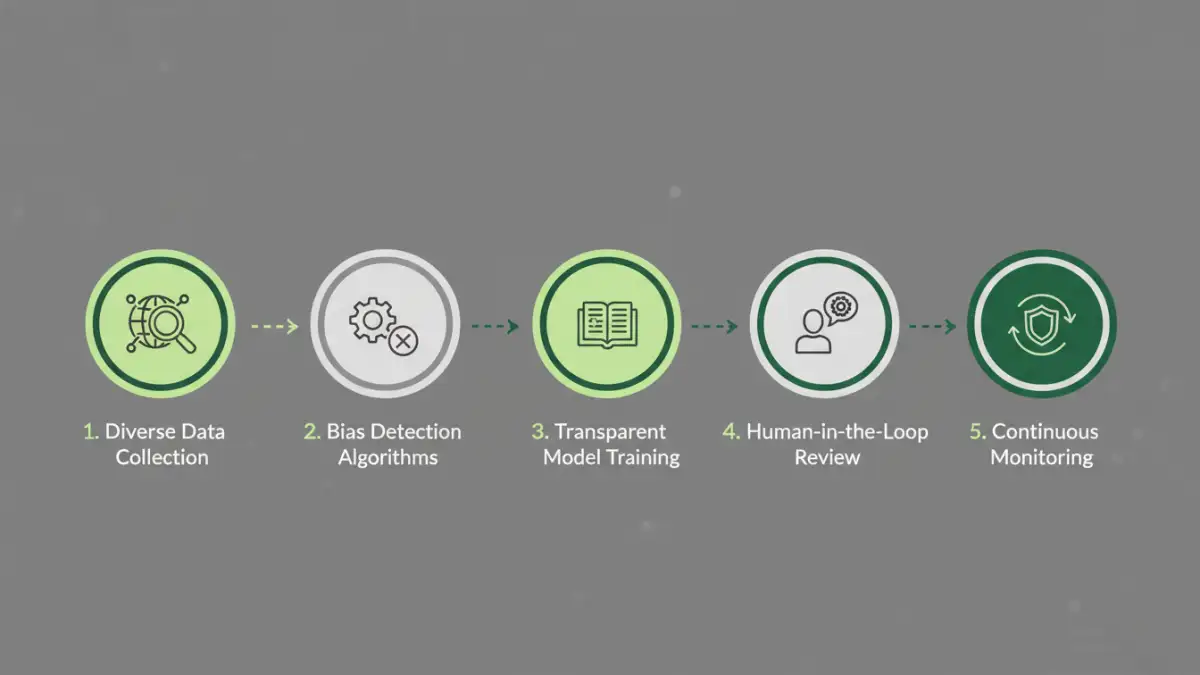
Mitigating bias requires a conscious and proactive approach throughout the development lifecycle. It starts with acknowledging that no dataset is perfectly neutral. The goal is to build systems that are robust, transparent, and fair. This is the core of responsible ai development.
One of the most effective strategies is to curate diverse and representative training datasets. This means actively seeking out data that includes a wide range of languages, cultural contexts, user types, and document formats. We also use techniques like data augmentation to create synthetic examples that help fill gaps in the training data, making the model more resilient.
Another key strategy is implementing human-in-the-loop (HITL) systems. Instead of letting the AI make final access decisions, it can flag potential issues for a human operator to review. This combines the AI's analytical power with human judgment and context, providing a crucial safeguard against algorithmic errors and allowing for continuous feedback to improve the model.
Core Principles for Responsible AI in Security
Creating truly effective and trustworthy systems requires adherence to a set of core principles. These guidelines help ensure that we are not just building powerful tools, but also ones that are equitable and safe. A commitment to ethical AI document security is non-negotiable for long-term success.
These principles should be integrated into every stage of the AI lifecycle, from initial design to deployment and ongoing monitoring:
- Fairness: The system should not produce discriminatory outcomes against individuals or groups. This requires regular audits and testing for bias across different demographics.
- Transparency: Stakeholders should be able to understand how the AI makes its decisions. Techniques like model explainability (XAI) are crucial for debugging and building trust.
- Accountability: There must be clear lines of responsibility for the AI's actions. When a system fails or makes a biased decision, there needs to be a process for remediation and correction.
- Privacy & Security: The system must protect user data and be resilient against adversarial attacks designed to manipulate or fool the AI.
By embedding these principles into our engineering culture, we can move from simply building automated systems to creating truly intelligent and responsible security frameworks.
AI Security Approach Comparison
| Approach | Description | Pros | Cons |
|---|---|---|---|
| Biased (Naive) Model | Trained on limited, unrepresentative historical data without bias checks. | Quick to develop; low initial cost. | Prone to discriminatory errors; creates security blind spots; erodes user trust. |
| Human-in-the-Loop (HITL) | AI flags potential issues, but a human makes the final decision. | Combines AI speed with human context; reduces false positives; provides feedback loop. | Slower than full automation; requires human resources. |
| Explainable AI (XAI) | Models are designed to provide clear reasoning for their decisions. | Builds trust; simplifies debugging and auditing; enhances transparency. | Can be computationally expensive; explanations may be complex. |
| Federated Learning | Trains a central model on decentralized data without exposing raw user data. | Enhances privacy; can leverage more diverse datasets. | Complex to implement; potential for non-IID data challenges. |
| Continuous Auditing | Regularly testing the model against new data to detect and correct bias drift. | Proactively identifies issues; ensures long-term fairness and accuracy. | Requires ongoing investment in monitoring infrastructure. |