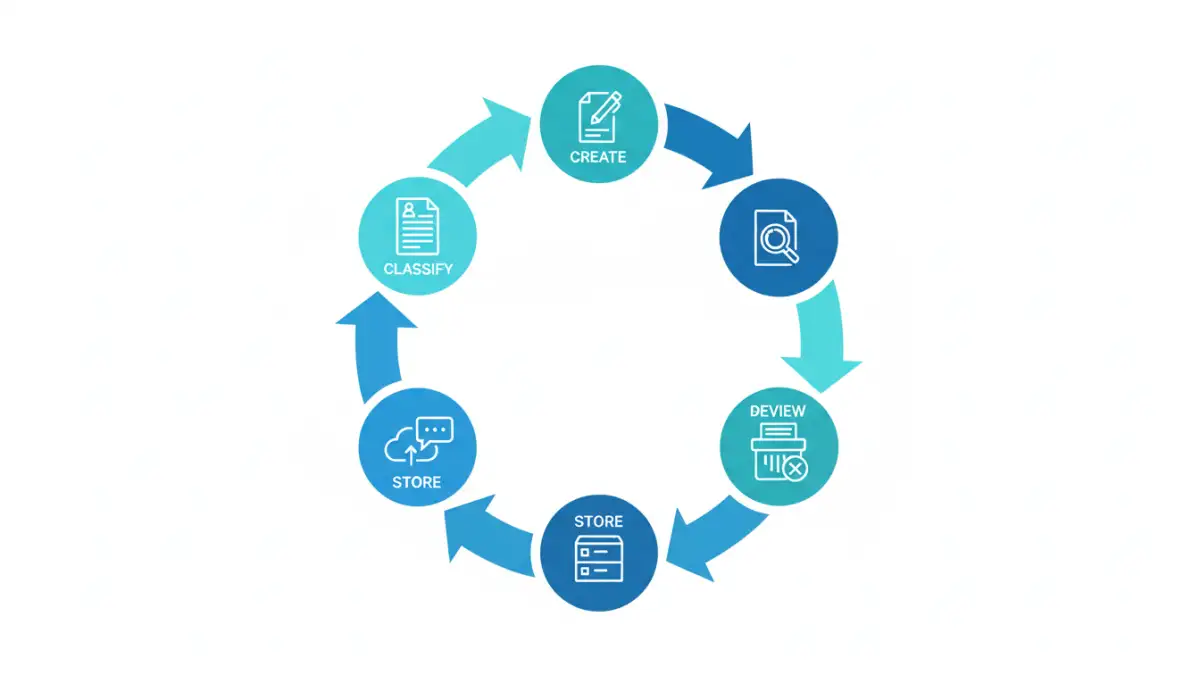
I once consulted for a mid-sized law firm drowning in digital files. They had client data from over a decade ago stored across personal drives, old servers, and various cloud accounts with no clear organization. Not only was finding anything a nightmare, but the risk of a data breach or non-compliance penalty was alarmingly high. This isn't an uncommon scenario; many firms accumulate data without a plan for its eventual, secure end-of-life.
Without a clear framework, you're exposed to unnecessary storage costs, legal liabilities, and significant security vulnerabilities. A well-structured plan for managing the entire client file lifecycle is not just good housekeeping—it's a critical business necessity for protecting your firm and your clients.
Table of Contents
Why a Document Retention Policy is Non-Negotiable
At its core, a document retention policy is a set of guidelines that dictates how long your firm must keep specific types of documents and how to dispose of them securely once that period ends. It’s a roadmap for data governance. Keeping every file forever is not a strategy; it’s a liability. Hoarding data increases your attack surface for cybercriminals and makes you vulnerable during legal discovery processes.
Failing to establish clear rules can lead to inconsistent practices where some employees delete crucial files prematurely while others hoard redundant data. This chaos complicates audits and can result in severe fines under regulations like GDPR, HIPAA, or industry-specific rules governing legal records retention. A formal policy brings order, ensuring everyone follows the same compliant procedures.
Legal and Security Imperatives
From a legal standpoint, you're often required to retain certain documents for a minimum period. For example, tax records, employee files, and client contracts all have legally mandated retention timelines. Conversely, holding onto data beyond its necessary lifespan can also create legal trouble, particularly if it contains sensitive personal information. A proper policy balances these requirements, ensuring you comply without over-retaining.
Core Components of an Effective Policy

A comprehensive policy is more than just a list of dates. It should be a detailed document that covers the entire lifecycle of your data. It must clearly define what constitutes a 'record' for your business, specify the retention periods for different categories of documents, and detail the procedures for destruction.
Your policy should also assign roles and responsibilities. Who is in charge of overseeing the policy? Who has the authority to approve document disposal? It should also include provisions for 'litigation holds,' a process to suspend the destruction of relevant documents when the firm anticipates or is involved in legal action. This prevents the accidental or intentional spoliation of evidence.
Defining Data Categories
The first practical step is to classify your data. Not all documents are created equal. Grouping them into logical categories makes setting retention rules much easier. Common categories include:
- Client Files: Case files, contracts, correspondence.
- Financial Records: Invoices, tax returns, payroll data.
- Employee Records: HR files, performance reviews, employment contracts.
- Administrative Documents: Internal memos, operational reports, vendor contracts.
For each category, you'll need to research and assign a specific retention period based on legal requirements, business needs, and industry standards. This is a crucial area where consulting with legal counsel is highly recommended, especially for law firm document management.
Creating Your Firm's Policy
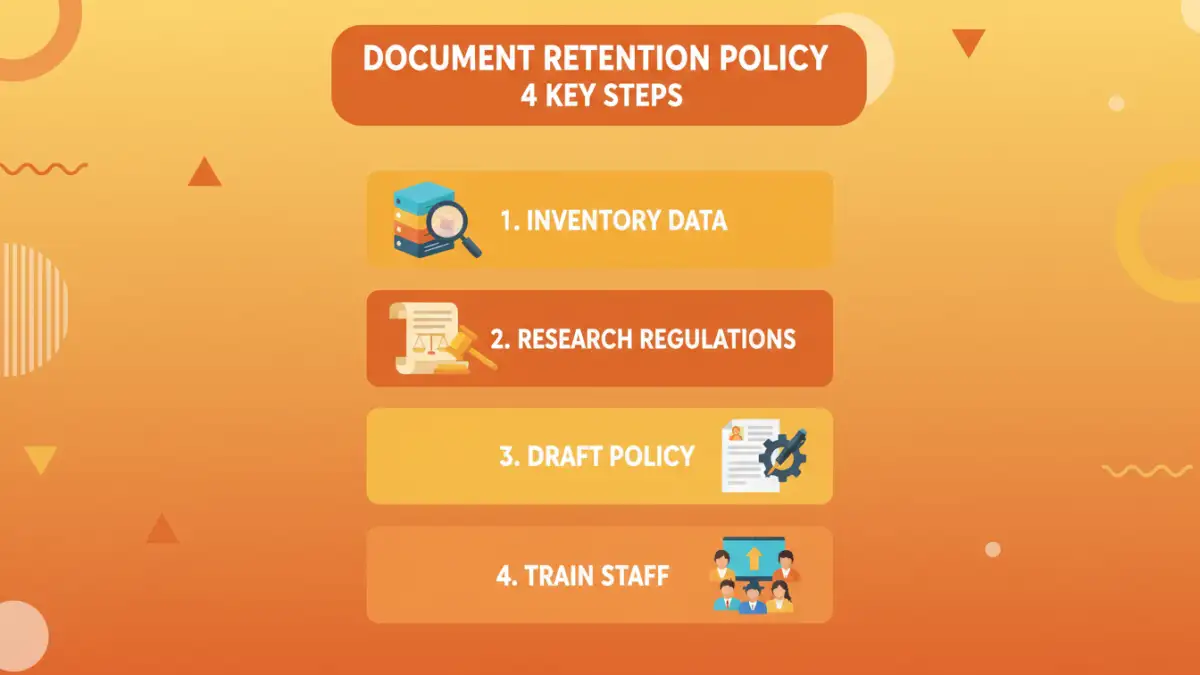
Developing a secure document retention policy doesn't have to be overwhelming if you break it down into manageable steps. The goal is to create a practical, enforceable, and compliant framework.
- Assemble a Team: Involve key stakeholders from legal, IT, HR, and management. This ensures the policy is comprehensive and has buy-in across the organization.
- Conduct a Data Inventory: You can't manage what you don't know you have. Map out where all your data lives—servers, cloud storage, physical archives, employee laptops—and what kind of data it is.
- Research Retention Requirements: Identify all federal, state, and industry regulations that apply to your business. This will form the backbone of your retention schedule.
- Draft the Policy: Write a clear, concise document outlining the data categories, retention periods, secure data disposal methods, and roles. Include the litigation hold procedure.
- Implement and Train: Roll out the policy and conduct mandatory training for all employees. Everyone needs to understand their responsibilities in managing the client file lifecycle.
Technology and Automation in Policy Enforcement
Manually managing document retention is prone to human error and becomes impossible at scale. This is where technology plays a vital role. Modern Document Management Systems (DMS) and information governance platforms can automate the enforcement of your policy.
These systems can automatically classify documents based on their content, apply the correct retention rules, and flag files for review or deletion when their lifecycle ends. They also provide robust access controls and audit trails, which are essential for proving compliance. For example, a DMS can be configured to automatically move a closed client file to an archive after one year and then permanently delete it after seven years, all without manual intervention.
Implementing automation not only improves efficiency but also drastically reduces the risk of non-compliance. It ensures that your secure data disposal protocols are followed consistently, protecting sensitive information from falling into the wrong hands even after it's no longer needed for business operations.
Document Retention Schedule Overview
| Document Category | Typical Retention Period | Reason | Secure Disposal Method |
|---|---|---|---|
| Client Case Files (Active) | Duration of case + 1 year | Ongoing business need | Archive |
| Client Case Files (Closed) | 7-10 years post-closure | Statute of limitations, professional liability | Cryptographic Erasure / Shredding |
| Corporate Tax Records | 7 years | IRS/Federal regulations | Shredding / Degaussing |
| Employee HR Files | 7 years post-employment | Employment law compliance | Shredding / Secure Deletion |
| Bank Statements | 7 years | Financial auditing and compliance | Shredding / Secure Deletion |
| Vendor Contracts | 6 years post-termination | Statute of limitations for contracts | Shredding / Cryptographic Erasure |