
I remember a project early in my career involving a massive document dump for a legal case. My team spent weeks manually blacking out names, account numbers, and addresses from thousands of PDF pages. It was tedious, mind-numbing, and terrifyingly prone to error. One missed social security number could have led to a significant data breach. That experience highlights a fundamental challenge many organizations face: how to efficiently and accurately protect sensitive information within documents.
Manual redaction is a relic of a bygone era. It's slow, expensive, and dangerously unreliable. The slightest lapse in concentration can expose confidential data. Today, we're on the cusp of a new approach that replaces human fatigue with machine precision, transforming how we handle document privacy.
Table of Contents
The Limits of Traditional Redaction
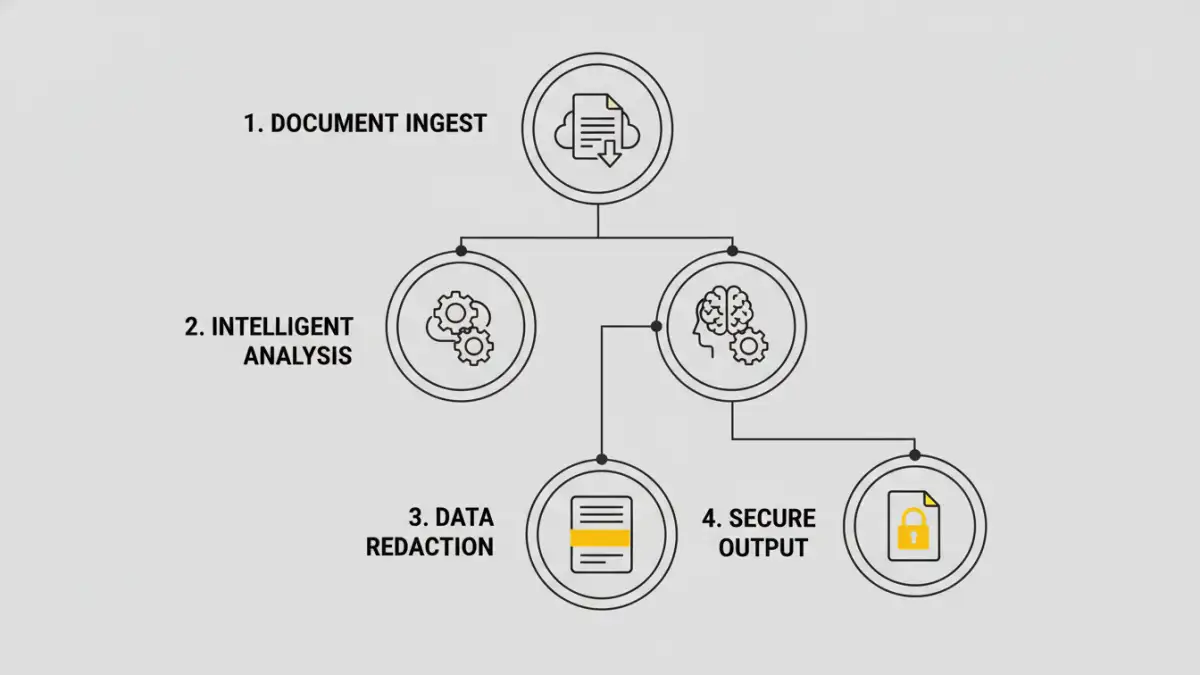
For years, the standard approach to redaction involved either a physical black marker or a digital black box tool in a PDF editor. While simple, this method is fraught with problems, especially at scale. The process is incredibly labor-intensive, requiring hours of focused work from detail-oriented personnel.
This manual effort is not just a drain on resources; it's a significant source of risk. Human error is inevitable. A reviewer might overlook a name mentioned in passing or fail to redact a date of birth. These small mistakes can lead to major compliance violations under regulations like GDPR, HIPAA, or CCPA, resulting in hefty fines and reputational damage. Furthermore, simple keyword-based redaction tools can't understand context, often redacting harmless words or missing sensitive data that doesn't fit a predefined pattern.
How AI Transforms Document Redaction
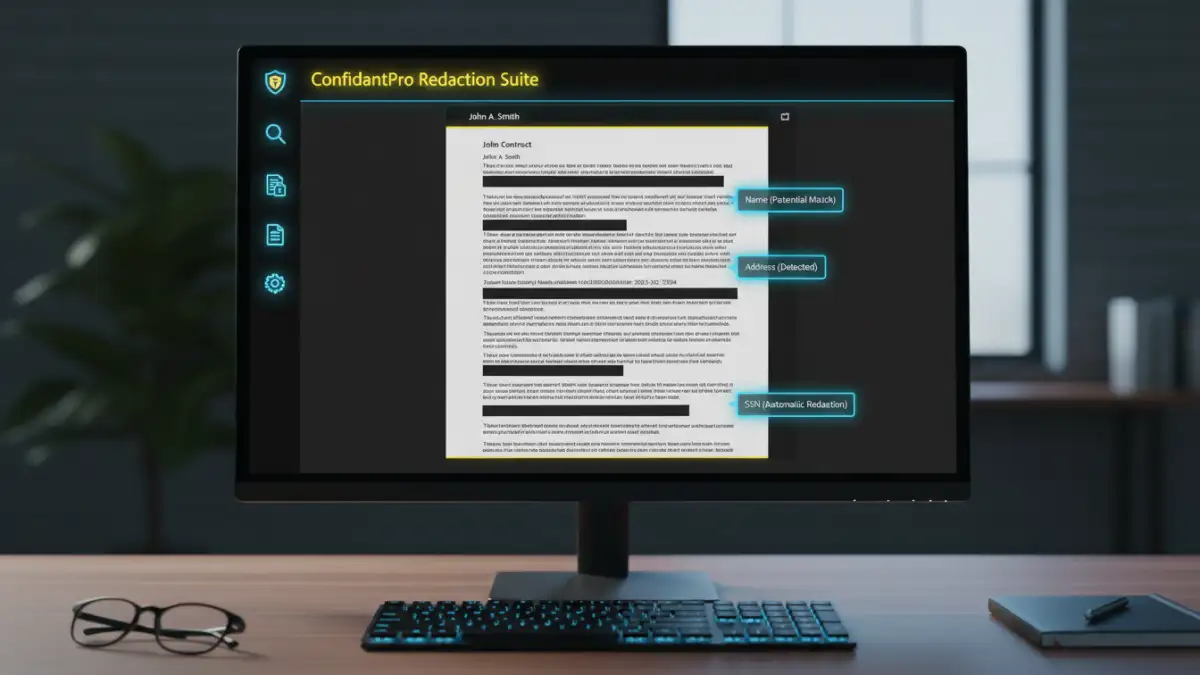
This is where the concept of ai powered pdf redaction completely changes the landscape. Instead of relying on a human to read every line or a simple tool to find specific words, an AI-driven system uses advanced algorithms to understand the document's content and context. It's the difference between telling someone to find the word "Account" and telling them to find all financial account numbers, regardless of how they are formatted.
Intelligent Document Analysis
At its core, an AI redaction system performs intelligent document analysis. It leverages Natural Language Processing (NLP) to comprehend the text, identifying entities like people, organizations, and locations. It can recognize personally identifiable information (PII) such as names, addresses, social security numbers, and credit card details, even when they appear in unstructured sentences. The AI learns to distinguish between a harmless sequence of numbers and a sensitive identifier based on surrounding context.
Automated Data Masking at Scale
The true power of this technology is its scalability. An AI platform can process thousands or even millions of pages in the time it would take a human to review a single large document. This capability for automated data masking ensures consistency across massive document sets. Every file is analyzed with the same level of scrutiny, eliminating the variability and fatigue that plague manual review processes.
Core Technologies Behind the Automation
Several key technologies work in concert to make smart redaction software effective. Understanding these components helps clarify how the system moves beyond simple pattern matching to achieve genuine comprehension.
First, Optical Character Recognition (OCR) is crucial for converting scanned documents and images into machine-readable text. Without high-quality OCR, the AI has no text to analyze. Next, Natural Language Processing (NLP) and Named Entity Recognition (NER) models are the brains of the operation. They parse sentences, identify grammatical structures, and classify words and phrases into predefined categories like 'Person,' 'Date,' or 'ID Number.' Finally, machine learning models are trained on vast datasets to improve their accuracy in identifying sensitive information and understanding nuanced context, making the entire process of sensitive data removal more reliable over time.
Practical Applications Across Industries
The applications for automated redaction are vast and cut across numerous sectors. In the legal field, law firms use it to expedite e-discovery and prepare documents for trial, saving countless billable hours. Healthcare organizations rely on it to de-identify patient records for research while maintaining HIPAA compliance.
Financial institutions use AI to redact customer PII from documents before they are shared for audits or analysis. Government agencies can process Freedom of Information Act (FOIA) requests more efficiently, redacting classified or private information before public release. In each case, the technology delivers a trifecta of benefits: enhanced security, improved operational efficiency, and stronger compliance posture.
Redaction Method Comparison
| Feature | Manual Redaction | Rule-Based Redaction | AI-Powered Redaction |
|---|---|---|---|
| Speed | Very Slow | Fast | Very Fast |
| Accuracy | Low (Prone to human error) | Medium (Misses context) | High (Understands context) |
| Scalability | Poor | Good | Excellent |
| Context Awareness | High (but inconsistent) | None | Very High |
| Cost per Document | High | Low | Very Low (at scale) |
| Best For | Small, one-off tasks | Structured data with fixed patterns | Large, unstructured document sets |