The encryption that protects our digital lives today, from banking to private messages, is incredibly robust against current computers. However, a new type of computing is on the horizon that changes the game entirely. As engineers, we can't just build for today; we have to build for tomorrow. That's why I'm excited to talk about our latest PQC update, which is a fundamental step toward ensuring your data remains secure for decades to come.
We've implemented a new layer of security designed to withstand attacks from both today's supercomputers and tomorrow's quantum machines. It’s about providing future proof document security, not just a temporary fix.
Table of Contents
The Looming Quantum Threat to Data Security
For years, the strength of our most common encryption methods has relied on mathematical problems that are practically impossible for classical computers to solve. Think of it like trying to find the two specific prime numbers that were multiplied together to create a massive, 500-digit number. A standard computer would have to guess and check for an astronomical amount of time—longer than the age of the universe.
Quantum computers, however, don't play by the same rules. They can process vast amounts of information simultaneously. An algorithm developed in the 90s, Shor's algorithm, is specifically designed to run on a quantum computer and can find those prime factors with alarming speed. Once large-scale quantum computers exist, they will effectively shatter the foundations of much of our current public-key cryptography.
Why Current Encryption Is So Vulnerable
The vulnerability lies in the specific mathematical architecture of asymmetric encryption algorithms like RSA and ECC, which are used everywhere to secure web traffic (HTTPS), emails, and digital signatures. They are based on problems that have a hidden structure, a structure that Shor's algorithm is perfectly suited to exploit.
This isn't a distant, theoretical problem. Malicious actors are already practicing what's known as "harvest now, decrypt later." They are collecting massive amounts of encrypted data today, knowing that they can store it and wait for the day a quantum computer is available to break the encryption and unlock the secrets inside. Any data with long-term sensitivity—government secrets, intellectual property, financial records—is at risk right now.
Introducing Post-Quantum Cryptography (PQC)
This is where our work on a new encryption standard comes in. Post-quantum cryptography, or PQC, refers to a new generation of cryptographic algorithms that are designed to be secure against attacks from both classical and quantum computers. These algorithms are not based on the prime factorization problems that Shor's algorithm can solve.
Instead, they are built on different, more complex mathematical problems that are believed to be hard for even a quantum computer to crack. The U.S. National Institute of Standards and Technology (NIST) has been running a multi-year competition to identify and standardize the most promising PQC algorithms. This rigorous process gives us confidence in the security and reliability of the new methods we are deploying.
How PQC Algorithms Work (A Simple View)
Without diving too deep into complex mathematics, many leading PQC candidates are based on problems like the "shortest vector problem" in a lattice. Imagine a vast, multi-dimensional grid of points (a lattice). Finding the point on that grid closest to the origin is an incredibly difficult problem to solve efficiently, even for a quantum computer. This inherent difficulty provides the foundation for a new, robust form of encryption.
By building our security on these types of problems, we are moving the goalposts. We are creating a new lock that requires a completely different kind of key—one that quantum computers don't have and aren't expected to be able to create.
What Our Update Means for Your Files
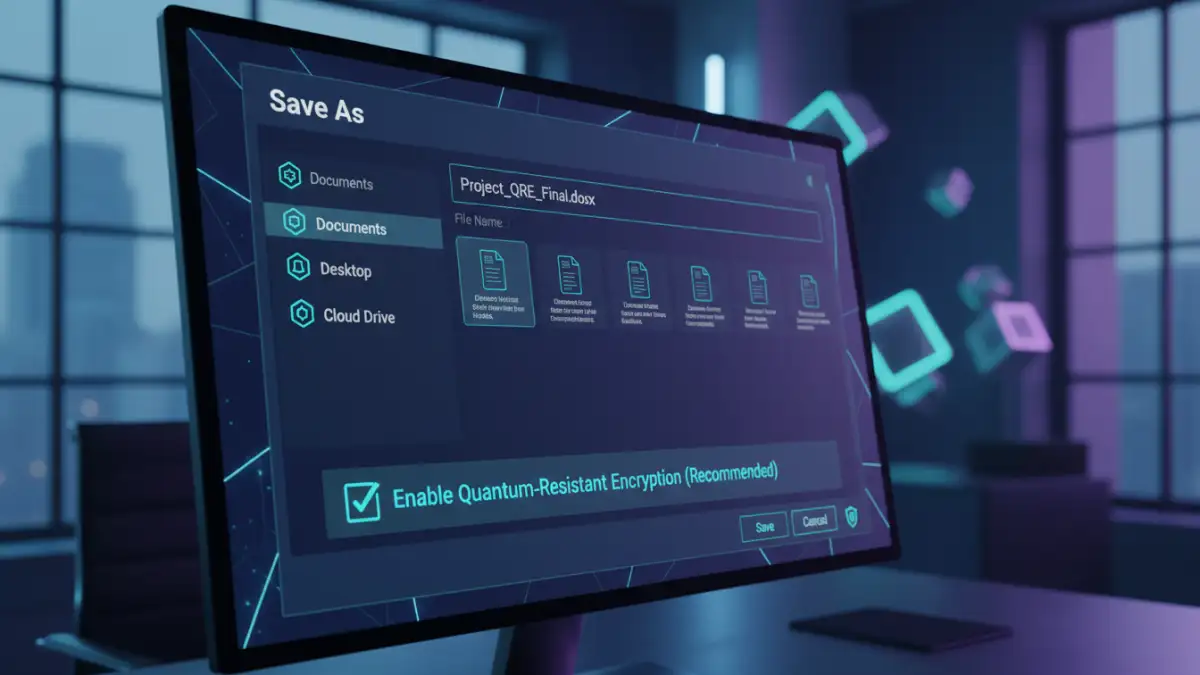
With our latest release, we have integrated a NIST-standardized PQC algorithm directly into our file encryption workflow. This isn't just a theoretical addition; it's a practical implementation of quantum resistant file encryption that you can use today. When you choose to encrypt a file, our software now uses a hybrid approach.
It combines a traditional, strong algorithm (like AES-256) with a new post-quantum algorithm. This ensures your files are protected by proven, industry-standard encryption while also being secured against future quantum threats. For the user, the process remains seamless. The complexity is handled entirely under the hood, providing a powerful security upgrade without requiring any specialized knowledge. You simply get the peace of mind that your data is protected for the long term.
The Benefits of Adopting a New Encryption Standard Today
Switching to a PQC-enabled system now is a proactive measure against a clear and present danger. Waiting until quantum computers are a reality is too late, especially for any data that needs to remain confidential for more than a few years. By adopting this standard now, you are safeguarding your information against the "harvest now, decrypt later" threat.
This PQC update ensures business continuity and protects sensitive intellectual property, financial data, and personal information from becoming vulnerable in the future. It's about building a foundation of trust and security that will last into the next era of computing. As an engineer, it's my job to solve problems, and migrating to PQC is the solution to a problem that will affect everyone.
Encryption Standard Comparison: Classical vs. Post-Quantum
| Standard | Basis of Security | Resilience to Classical Computers | Resilience to Quantum Computers | Primary Use Case |
|---|---|---|---|---|
| RSA/ECC | Integer Factorization / Elliptic Curves | High | Vulnerable (Shor's Algorithm) | Web (HTTPS), Digital Signatures |
| AES | Symmetric-key Block Cipher | High | Resistant (Requires larger keys) | Data-at-rest, File Encryption |
| CRYSTALS-Kyber (PQC) | Lattice-based Cryptography | High | Resistant | Key Encapsulation (replacing RSA) |
| CRYSTALS-Dilithium (PQC) | Lattice-based Cryptography | High | Resistant | Digital Signatures (replacing RSA) |