
Imagine needing to run a spell check on a highly confidential legal document stored in the cloud. To perform that check, the cloud service typically needs to decrypt the file first, momentarily exposing its contents. This creates a significant vulnerability. What if you could perform operations on that document while it remained completely encrypted? That's the core promise of homomorphic encryption.
This technology isn't just theoretical; it represents a fundamental shift in how we approach data security. Instead of the traditional encrypt-transfer-decrypt-process cycle, we can now process data in its protected state. As an engineer who has implemented various security protocols, I see this as one of the most exciting developments for the future of cloud document security.
Table of Contents
What Is Homomorphic Encryption?
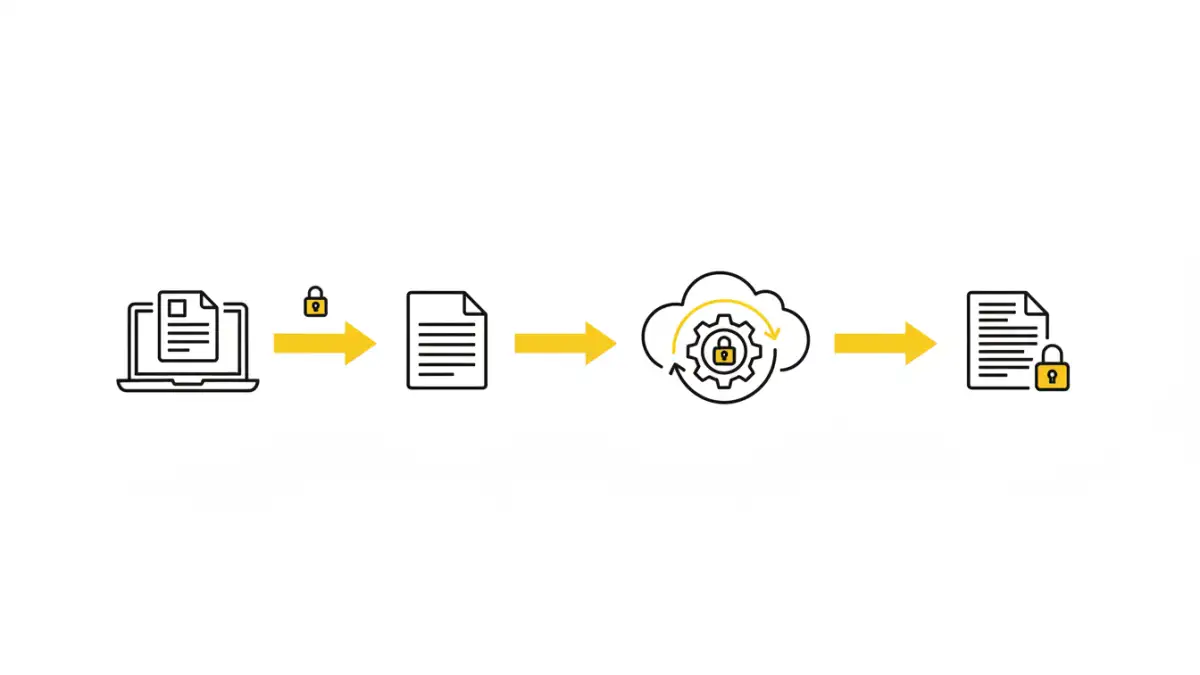
Homomorphic encryption is a type of cryptography that allows computation to be performed directly on ciphertext. In simple terms, you can apply functions—like searching for a keyword, counting words, or analyzing data—to an encrypted file and get an encrypted result. When you decrypt this result, it's the same as if you had performed the operation on the original, unencrypted file.
This breaks the conventional security model. Standard encryption is like a locked box; you have to unlock it (decrypt) to see or change what's inside. Homomorphic encryption is like a special, transparent locked box with built-in gloves. You can't see the contents clearly, but you can manipulate them from the outside, and the box remains locked the entire time.
The 'Magic' Analogy
A classic analogy involves a jewelry maker who doesn't trust their workers. The owner puts raw materials (gold, gems) into a locked, transparent glove box (encryption). The workers can use the attached gloves to assemble a necklace (computation) without ever touching the raw materials directly. The finished necklace remains in the locked box (encrypted result) until the owner opens it with their private key.
Why It's a Game-Changer for Documents
For documents stored on third-party servers like Google Drive or Dropbox, this is revolutionary. It means the service provider could offer advanced features like spam filtering for encrypted emails, virus scanning for encrypted files, or data analytics on sensitive financial spreadsheets without ever having access to the underlying plaintext data. This enables true privacy preserving computation.
How Does It Work with Documents?

Implementing a system that uses homomorphic encryption for secure documents involves a specific workflow. While the underlying mathematics are incredibly complex, involving lattice-based cryptography, the practical steps are more straightforward to conceptualize.
The process ensures that the document's contents are never exposed on the server where the computation happens. This is a critical distinction from encryption-at-rest or in-transit, which only protect data when it's stored or being moved, not while it's being processed.
The Basic Workflow
The workflow for processing an encrypted document generally follows these steps:
- Encryption: The user encrypts their document on their local machine using a public key before uploading it to the cloud.
- Upload: The encrypted document (ciphertext) is sent to the cloud server.
- Computation: The user requests an operation (e.g., 'find all instances of the word contract'). The server applies a homomorphic function to the ciphertext to perform this search.
- Encrypted Result: The server generates an encrypted result and sends it back to the user. The server never sees the original document or the search results in plaintext.
- Decryption: The user decrypts the result on their local machine using their private key to view the outcome.
Key Types of Homomorphic Encryption
Homomorphic encryption isn't a one-size-fits-all solution. Different schemes exist, offering a trade-off between computational complexity, performance, and the types of operations they support. For years, the performance overhead made it impractical for most uses, but recent advancements have brought it closer to reality.
Partially Homomorphic Encryption (PHE) schemes can perform one type of operation (either addition or multiplication) an unlimited number of times. Somewhat Homomorphic Encryption (SHE) can perform a limited number of both addition and multiplication operations. The ultimate goal, Fully Homomorphic Encryption (FHE), supports an unlimited number of any kind of computation.
Real-World Applications for Secure Documents
The potential applications are vast, especially as performance improves. We are moving beyond theoretical discussions to practical implementations in specific, high-stakes industries where privacy is non-negotiable.
One of the most promising areas is encrypted collaboration. Imagine a team of lawyers editing a sensitive contract stored in the cloud. With a system built on homomorphic file encryption, they could collaboratively make changes, add comments, and track revisions without the cloud provider ever having access to the document's confidential terms. Other key applications include secure medical record analysis, private financial audits, and confidential intellectual property management.
Homomorphic Encryption Scheme Comparison
| Scheme Type | Supported Operations | Performance Overhead | Best Use Case |
|---|---|---|---|
| Partially Homomorphic (PHE) | Unlimited additions OR multiplications, but not both. | Low | Simple tasks like secure voting or statistical sums. |
| Somewhat Homomorphic (SHE) | Limited number of additions AND multiplications. | Medium | Evaluating low-complexity functions on encrypted data. |
| Fully Homomorphic (FHE) | Unlimited additions AND multiplications. | High | Complex, general-purpose secure data processing. |
| Levelled FHE | A practical implementation of FHE that supports a pre-set number of operations. | Medium-High | The basis for most modern practical FHE libraries. |