I recently helped a colleague who couldn't access an important encrypted ZIP archive. The password was set by an employee who had left the company, and nobody could find a record of it. This situation highlights a common problem: how do you regain access to your own data when a password is lost? The two most fundamental approaches to this are the dictionary attack and the brute force attack.
Understanding these password recovery methods is crucial not just for getting out of a jam, but also for appreciating why strong, complex passwords are so important for security. Each method has its own logic, strengths, and weaknesses, and choosing the right one depends entirely on the situation.
Table of Contents
Password Recovery Fundamentals
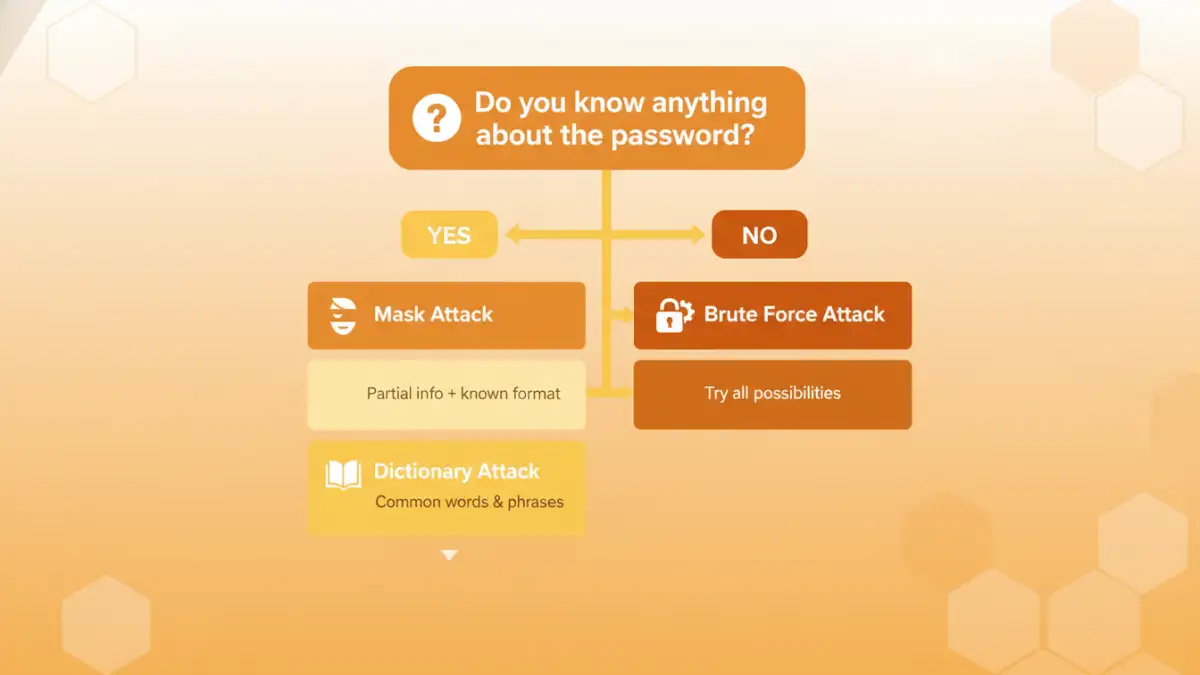
Before we compare the two main techniques, it's important to clarify that we're talking about password recovery, not malicious hacking. These methods are used by security professionals and system administrators to regain access to legitimate files. The goal is to systematically guess the password until the correct one is found.
The effectiveness of any password recovery attempt depends on several factors: the complexity of the password, the encryption strength of the file (like AES-256 used in modern ZIP files), and the computational power available. A simple, short password might be found in seconds, while a long, complex one could take centuries with current technology.
The Dictionary Attack: A Strategic Guessing Game

A dictionary attack is an intelligent, targeted approach. Instead of trying every possible character combination, it uses a predefined list of words, or a 'dictionary,' to guess the password. This list isn't just the English dictionary; it can contain millions of entries.
These lists often include common passwords, names, places, famous quotes, and even passwords from previous data breaches. The logic is based on the human tendency to use memorable, and therefore predictable, words or phrases. For many years in my own development work, I've seen how often default or simple passwords like 'password123' or 'admin' are used, which are prime targets for this method.
How It Works and Its Limitations
The process is straightforward: the software takes each word from the list, tries it as the password, and moves to the next if it fails. Some tools can also apply common mutations, like adding numbers ('password2024'), capitalizing letters ('Password'), or substituting characters ('P@ssword'). This is sometimes called a hybrid dictionary attack.
The primary limitation is obvious: if the password is not in the dictionary or a simple variation of a word in it, the attack will fail completely. A password like 'qZ5!x#9p' has zero chance of being found with a standard dictionary attack because it's just random characters.
The Brute Force Attack: Trying Every Combination
The brute force attack is the opposite of the dictionary method. It's not strategic; it's exhaustive. This method systematically attempts every single possible combination of characters until it finds the correct password. It's the digital equivalent of trying every key on a massive key ring to open a lock.
It starts simple (e.g., 'a', 'b', 'c'...) and gradually increases in length and complexity ('aa', 'ab', 'ac'... 'aA', 'aB', 'a1', 'a2'...). Given enough time, a brute force attack is guaranteed to find the password. The key phrase here is 'enough time,' which can range from seconds to millennia.
Pure Brute Force vs. Hybrid Attacks
A pure brute force attack tries all combinations within a given character set (e.g., lowercase letters, uppercase, numbers, symbols). The time required grows exponentially with each additional character in the password's length and each new character set added.
A hybrid attack combines brute force with other methods. For example, it might start with a dictionary word and then append brute-force combinations of numbers or symbols at the end (e.g., 'sunshine' + '00' to '99'). This can be more efficient if you suspect the password follows a pattern, which is a common scenario in file password cracking attempts.
Head-to-Head: Brute Force vs Dictionary Attack
So, which method is better? The answer is, it depends on the password. A dictionary attack is much faster if the password is a common word or a simple variation. I've seen it unlock an encrypted archive in minutes because the password was a slightly modified company name.
However, for a truly random and complex password, the dictionary attack is useless. This is where brute force becomes the only option. It's a slow, resource-intensive process that relies heavily on the power of your computer's CPU or GPU, but it's comprehensive. Modern password recovery tools often start with a dictionary attack and then, if that fails, move on to a more targeted brute force approach.
Practical Considerations and Tools
When you need to unlock an encrypted archive, choosing the right tool is important. Many ZIP password attack types are supported by software like John the Ripper or Hashcat, which are powerful but have a steep learning curve. For more user-friendly options, commercial software often provides a graphical interface that lets you configure the attack type easily.
Before starting any attack, it's wise to gather any information you can about the potential password. Was it set by a person who often uses pet names? Did they typically add the year at the end of passwords? This information can help you configure a more efficient hybrid attack, saving potentially days or weeks of processing time.
Attack Method Comparison
| Attack Method | Speed | Success Rate | Best For |
|---|---|---|---|
| Dictionary Attack | Very Fast | Low (depends on password) | Common words, predictable passwords, or when you have a list of potential candidates. |
| Brute Force Attack | Extremely Slow | Guaranteed (with enough time) | Short passwords (under 8 characters) or when you have no information about the password. |
| Hybrid (Dictionary + Brute Force) | Moderate | Higher than pure dictionary | Passwords that combine a word with numbers or symbols, like 'password123' or 'Secret!'. |
| Mask Attack (Targeted Brute Force) | Faster than pure brute force | High (if pattern is known) | When you know parts of the password, like its length or that it ends in '2024'. |