The landscape of digital identity and trust services in the European Union is undergoing its most significant transformation in a decade. With the final approval of eIDAS 2.0, the framework that governs electronic signatures and transactions is evolving. For anyone involved in building systems that handle contracts, approvals, or any form of legally binding digital agreement, understanding these changes isn't just beneficial—it's essential for future compliance and innovation.
I've worked on several projects that integrated with Trust Service Providers (TSPs) under the original eIDAS regulation, and the shift towards a user-centric digital wallet model is a monumental one. It moves the control of identity firmly into the hands of the individual, which has profound implications for how we verify signatories and ensure document integrity.
Table of Contents
A Quick Recap: What Was eIDAS 1.0?
Before we explore the new updates, it's helpful to remember the foundation eIDAS 1.0 laid. Established in 2014, the original Electronic Identification, Authentication and Trust Services regulation aimed to create a single, predictable legal framework for electronic transactions across EU member states. It was designed to eliminate friction in cross-border business by making electronic signatures and other trust services as legally valid as their paper-based counterparts.
The goal was to build trust in the online environment. It standardized three levels of electronic signatures: Simple (SES), Advanced (AES), and Qualified (QES). A QES, the highest level, holds the same legal weight as a handwritten signature throughout the EU. This was made possible by a network of certified Trust Service Providers (TSPs) who were responsible for verifying identities and issuing the digital certificates needed for these high-assurance signatures.
Core Principles of the Original Framework
The original regulation was built on the principle of non-discrimination, meaning an electronic signature couldn't be denied legal effect simply because it was in an electronic form. It established a clear digital signature law for the entire bloc. It also defined roles for TSPs, who acted as the trusted third parties for services like issuing certificates for electronic signatures, seals, and website authentication. While revolutionary, the system was often seen as fragmented, with different identity verification methods across member states.
The Next Chapter: Key Changes in eIDAS 2.0

The new regulation, eIDAS 2.0, addresses the limitations of its predecessor by introducing a groundbreaking concept: the European Digital Identity Wallet (EUDIW). This is the centerpiece of the update and represents a fundamental shift from a provider-centric model to a user-centric one. Instead of relying solely on TSPs for identity verification for every transaction, citizens will have a personal digital wallet on their mobile devices.
This wallet, offered by each member state, will allow users to securely store and share verified identity attributes (like name, age, or professional qualifications) with a simple tap. The goal is to give citizens full control over their personal data, deciding exactly what information to share, with whom, and for what purpose. This harmonizes digital identity across the EU in a way eIDAS 1.0 never could.
The European Digital Identity Wallet (EUDIW) Explained
Think of the EUDIW as a digital equivalent of your physical wallet. It will link your national digital identity with proof of other personal attributes. For example, you could use it to prove your age to access age-restricted services, present a mobile driver's license, or access health records without sharing unnecessary personal data. From a technical standpoint, this requires robust security measures, standardized APIs, and a high level of interoperability so that a wallet issued in Spain is seamlessly accepted in Germany.
How eIDAS 2.0 Redefines Secure Document Signing
The introduction of the EUDIW has a direct and powerful impact on trusted document signing. The new framework will allow citizens to use their wallets to create Qualified Electronic Signatures (QES) remotely, for free. This democratizes access to the highest level of signature security, which was previously a more complex and often costly process managed by TSPs.
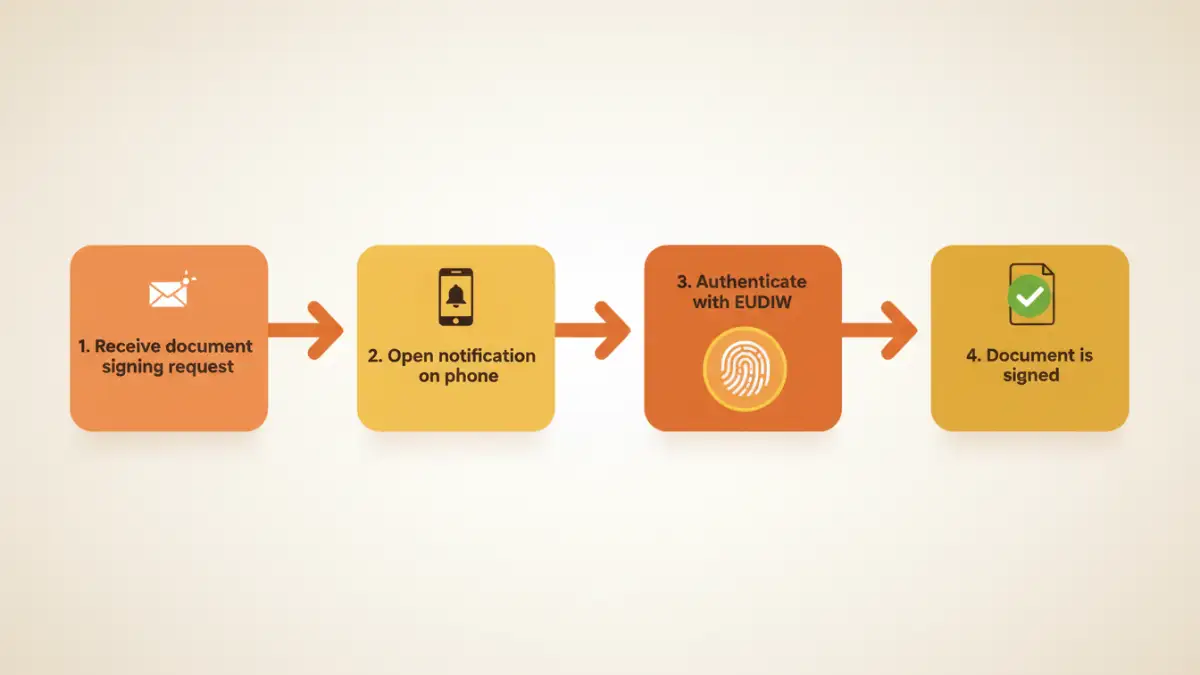
For a typical user, the process will become much smoother. When prompted to sign a document with a QES, they will receive a notification on their phone. They can then authenticate themselves using their EUDIW (likely via biometrics or a PIN) to authorize the creation of the signature. This simplifies the user experience for eidas secure document signing while maintaining the stringent security requirements of a QES. The identity verification is intrinsically linked to the government-verified identity within the wallet.
Practical Implications for Developers and Businesses
For software engineers and businesses, eIDAS 2.0 presents both opportunities and challenges. The primary task will be integrating systems with the new EUDIW ecosystem. This will involve working with new APIs and standards to request identity attributes and trigger signature ceremonies through the wallets. The reliance on a standardized wallet infrastructure could simplify cross-border customer onboarding and verification processes significantly.
Compliance will also be a key focus. Platforms that offer or rely on electronic signatures will need to adapt their workflows to support EUDIW-based signing. This means updating user interfaces, backend logic, and security protocols. However, the benefit is a more streamlined, secure, and universally accepted method for identity verification and signing, reducing fraud and administrative overhead in the long run.
Comparison Table: eIDAS 1.0 vs. eIDAS 2.0
| Feature | eIDAS 1.0 (The Original) | eIDAS 2.0 (The Update) |
|---|---|---|
| Primary Identity Model | Federated model based on notified national eID schemes. Often fragmented. | Harmonized, user-centric model via the European Digital Identity Wallet (EUDIW). |
| QES Creation | Primarily managed by commercial Trust Service Providers (TSPs); often involved costs for users. | Users can create QES for free using their government-issued EUDIW. |
| Data Control | Data shared with relying parties on a case-by-case basis, controlled by service providers. | Users have direct control over which identity attributes they share (selective disclosure). |
| Scope of Trust Services | Focused on signatures, seals, timestamps, and website authentication. | Expands to include electronic ledgers and the management of electronic attribute attestations. |
| User Experience | Could be cumbersome, requiring different verification methods for each service or country. | Aimed to be seamless and mobile-first, using the EUDIW for one-tap verification and signing. |