A few years ago, verifying a digital signature on a cross-border contract was a tangled mess of different national standards and trust service providers. I remember working on a project that required integrating multiple signing APIs just to cover a few EU member states. Now, with the evolution of EU regulations, that landscape is changing dramatically, moving towards a unified, citizen-controlled system.
The upcoming eIDAS 2.0 regulation is not just an update; it's a fundamental shift in how we handle digital identity and, by extension, secure our most important documents. It introduces the European Digital Identity (EUDI) Wallet, a tool poised to become central to our digital lives, including how we execute trusted document signing.
Table of Contents
A Quick Recap: What Was eIDAS 1.0?
Before we can appreciate the changes, it's important to understand the foundation. The original eIDAS Regulation (EU) No 910/2014 was a landmark piece of digital signature law. Its primary goal was to create a predictable, standardized regulatory environment for electronic identification and trust services across the European Union. It aimed to make cross-border electronic transactions as seamless as domestic ones.
Essentially, eIDAS 1.0 established a common legal framework for electronic signatures, seals, time stamps, and other trust services. This meant that a qualified electronic signature from Spain held the same legal weight as a handwritten signature in Germany, removing significant friction for international business.
The Three Tiers of Electronic Signatures
eIDAS 1.0 defined three distinct levels of electronic signatures, each with a different level of security and legal standing:
- Simple Electronic Signature (SES): The most basic form, like a scanned image of a signature or even just typing your name at the end of an email. It has no specific security requirements but is admissible in court.
- Advanced Electronic Signature (AdES): This level is more secure. It must be uniquely linked to the signatory, capable of identifying them, created using data that the signatory can control, and linked to the signed data in such a way that any subsequent change is detectable.
- Qualified Electronic Signature (QES): The gold standard. A QES is an AdES created with a qualified certificate and a secure signature creation device. Legally, it is the full equivalent of a handwritten signature across all EU member states.
Enter eIDAS 2.0: The EUDI Wallet Revolution
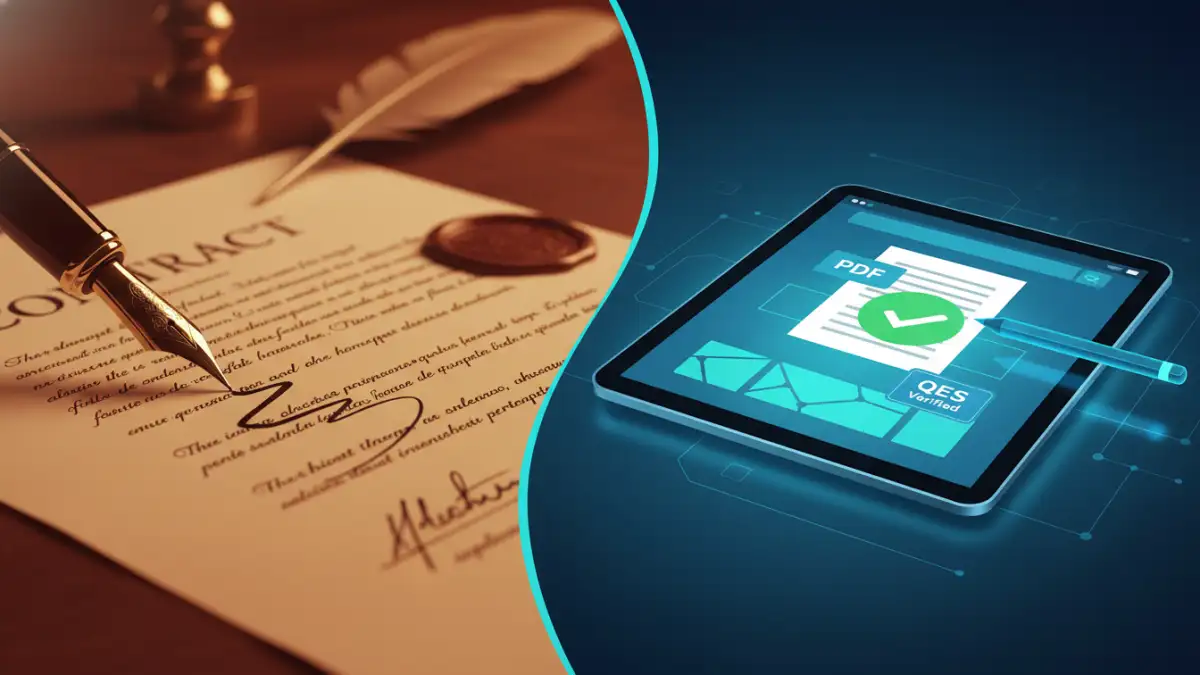
While the first iteration was successful in standardizing trust services, it relied heavily on commercial Trust Service Providers (TSPs). eIDAS 2.0 represents a paradigm shift by placing control directly into the hands of citizens through the European Digital Identity (EUDI) Wallet.
The EUDI Wallet is a personal digital wallet app that will allow EU citizens to store and manage their identity data, credentials, and attributes (like a driver's license, university diploma, or professional qualification). This initiative for secure electronic identification aims to empower individuals, giving them sole control over what data they share, with whom, and when.
Instead of logging into services with a password or a social media account, you'll use your EUDI Wallet to prove your identity. The same principle will apply to signing documents, which is where things get really interesting for document security.
The Direct Impact on PDF Security and Signing
The biggest change for document workflows is how Qualified Electronic Signatures will be generated. With eIDAS 2.0, citizens will be able to create a QES directly from their EUDI Wallet, free of charge for personal use. This democratizes the highest level of digital signature security, making it accessible to everyone.
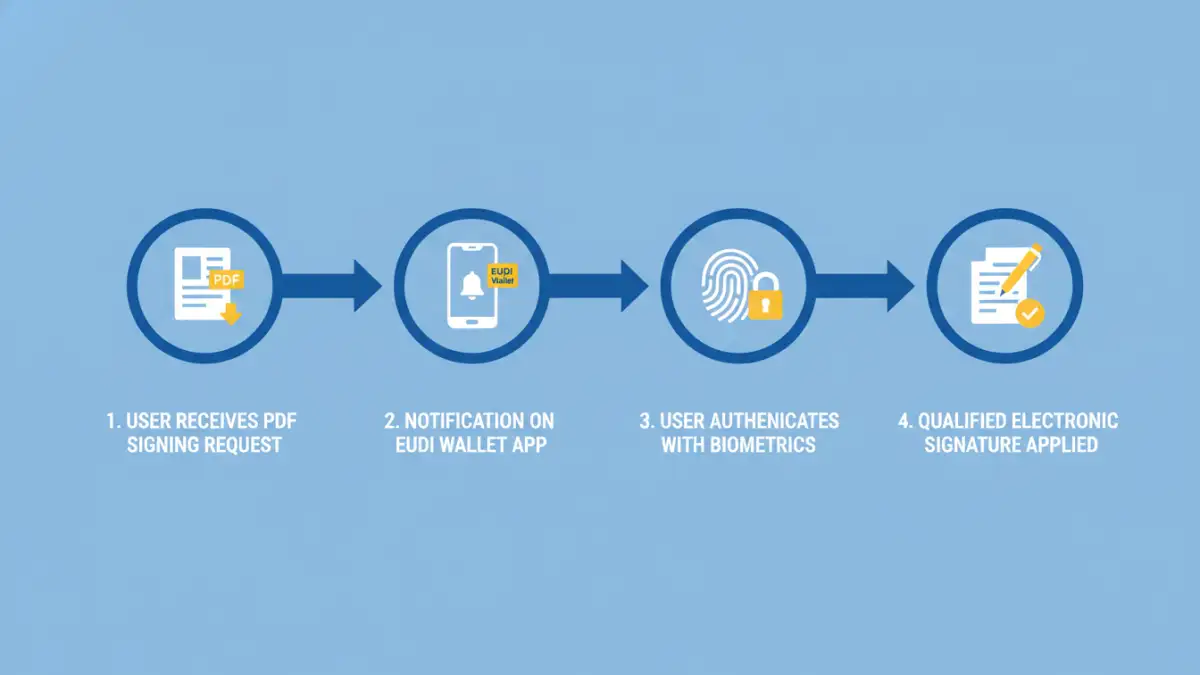
Imagine receiving a PDF contract on your laptop. Instead of using a third-party signing service that requires you to create an account and go through a complex verification process, you'll simply get a prompt on your phone. You'll authenticate yourself within your EUDI Wallet (likely using biometrics), and the QES is applied to the document. The process is seamless, incredibly secure, and rooted in a legally recognized identity framework.
From Centralized Providers to Decentralized Control
This new model fundamentally enhances eidas pdf security by decentralizing the creation of trust. Previously, you relied entirely on a Qualified Trust Service Provider (QTSP) to issue and manage your signing certificate. Now, the wallet becomes the secure signature creation device, directly under your control.
This reduces dependencies on external commercial entities for the act of signing and puts the user firmly in charge. The cryptographic keys used for signing are managed within the secure environment of the wallet, providing a robust defense against forgery and tampering. Every signature is backed by the verified identity attributes stored in your personal wallet.
Practical Implications for Developers and Businesses
From a software engineer's perspective, this is a massive change. We're moving from integrating disparate, proprietary APIs from various TSPs to a standardized architecture defined by the EU. The European Commission will provide a common library and technical specifications to ensure all EUDI Wallets are interoperable.
This means businesses will need to update their applications and document management systems to support authentication and signing via the EUDI Wallet. While this requires initial development effort, the long-term benefit is a single, pan-European integration point for identity verification and legally binding signatures. It simplifies compliance and opens up new possibilities for secure, automated digital workflows.
The transition will be gradual, but the direction is clear. Businesses that handle sensitive documents, from financial institutions to legal firms, will need to prepare for this new ecosystem to remain compliant and offer their customers the most secure and convenient experience.
Comparison: eIDAS 1.0 vs. eIDAS 2.0 for Document Signing
| Feature | eIDAS 1.0 | eIDAS 2.0 |
|---|---|---|
| Primary Focus | Standardizing trust services and signatures. | Creating a unified digital identity framework. |
| Control of Identity | Held by individual Trust Service Providers (TSPs). | Held by the citizen via the EUDI Wallet. |
| QES Creation | Requires a certificate from a Qualified TSP, often with a fee. | Can be generated directly from the EUDI Wallet, free for personal use. |
| User Experience | Often fragmented, requiring separate accounts with signing services. | Seamless, integrated into a single, trusted wallet app. |
| Integration Model | Businesses integrate with multiple proprietary TSP APIs. | Businesses integrate with a standardized, interoperable wallet framework. |
| Scope | Focused on signatures, seals, and timestamps. | Expands to include verifiable attributes and attestations (e.g., diplomas). |