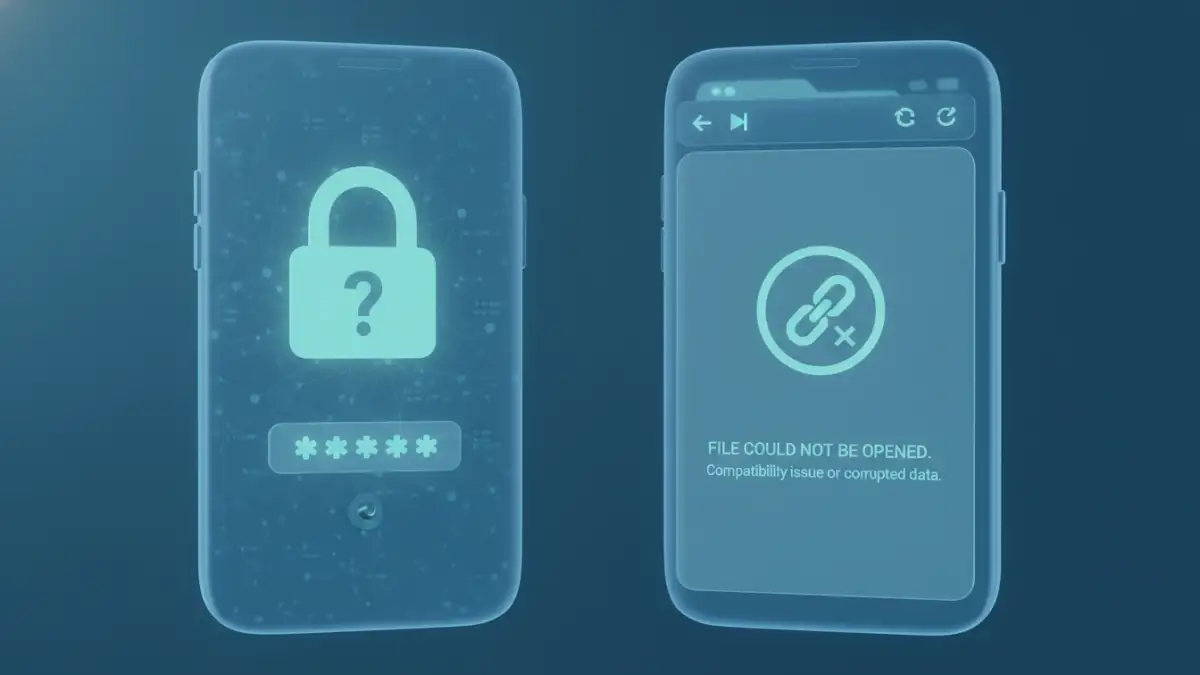
You're away from your desk, and an urgent, password-protected report lands in your inbox. You tap the link on your phone, expecting to quickly review it, but instead, you're met with a blank screen or a cryptic error message. It's a frustratingly common scenario that highlights a fundamental limitation of our otherwise powerful mobile devices.
This isn't a bug; it's a matter of design. Mobile browsers are built for speed and rendering web pages, not for handling complex, encrypted documents. Let's break down why this happens and what you can do about it.
Table of Contents
Why Mobile Browsers Fail with Protected Files
The core of the issue lies in what a web browser is designed to do. Its primary job is to interpret and display web content like HTML, CSS, and JavaScript. While many have basic built-in viewers for common file types like PDFs, these are often lightweight and lack advanced features, especially robust decryption capabilities.
The Browser's Limited Role
Think of your mobile browser's file viewer as a quick-look tool, not a full-featured application. It can render a simple, unsecured PDF just fine. However, when it encounters a file with AES-256 encryption (a common standard for password protection), it doesn't have the necessary cryptographic engine to process the password and decrypt the contents. It simply sees a block of unreadable data and gives up.
Security Sandboxing
Mobile operating systems like Android and iOS use a security model called 'sandboxing.' Each app, including each browser tab, runs in its own isolated environment. This is great for security, as it prevents a malicious website from accessing data in your other apps. However, it also means the browser has very limited access to the file system and other applications, preventing it from calling on a more powerful tool to handle the decryption.
Common Errors on Android and iOS

Because the browser isn't equipped to handle these files, the failure manifests in different ways depending on your device. Recognizing these symptoms can help you quickly identify the problem.
On an iPhone or iPad, you'll frequently encounter an ios pdf password error where the file appears as a blank white or grey page in Safari or the Mail app. There's no prompt for a password and no indication of what's wrong. This is a classic safari mobile pdf issue where the built-in viewer simply fails silently.
On Android devices, you might see a more direct chrome for android file error. This could be a message like "Cannot display PDF," "File is corrupted," or a download that never seems to complete. The file isn't actually corrupted; Chrome's native viewer just hit the encryption wall and couldn't proceed.
Proven Solutions to Open Secure Files
Fortunately, getting around this limitation is straightforward. The solution is to stop trying to make the browser do a job it's not designed for and instead use an application that is. The key is to get the file out of the browser and into a capable app.
Method 1: Download and Open with a Dedicated App
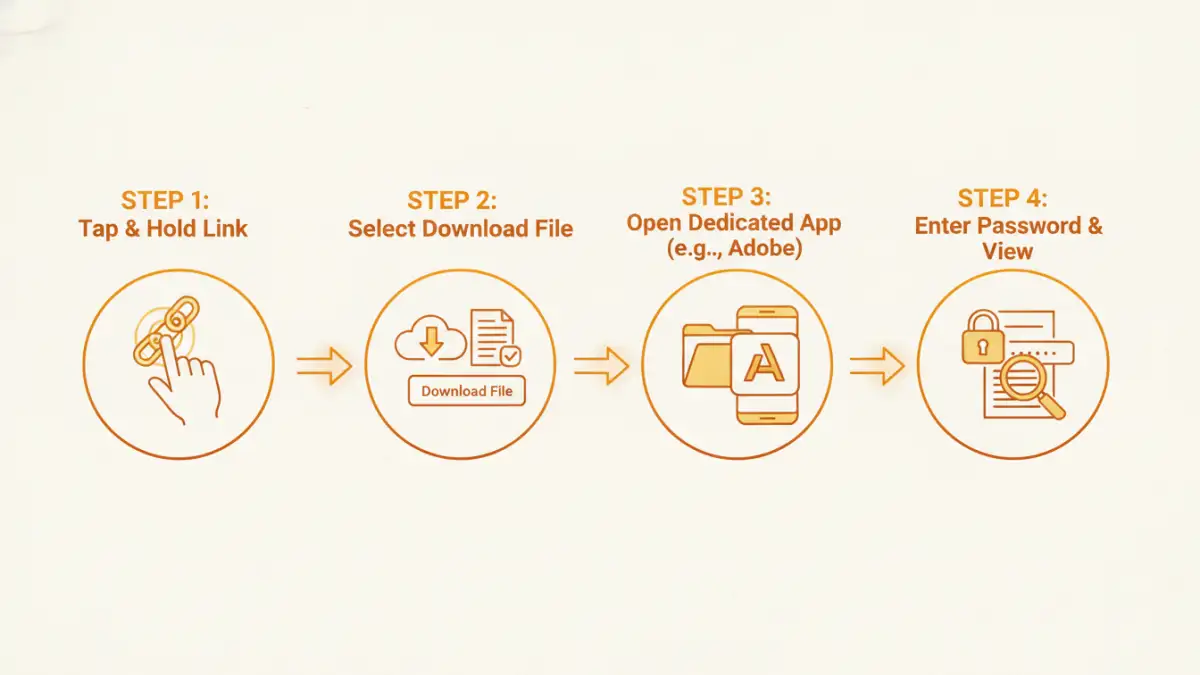
This is the most reliable method to open secure pdf on android or iOS. Instead of tapping to view, you need to save the file first.
- Download the File: When you encounter the link, long-press on it or find the download button. Save the file directly to your device's local storage ('Downloads' folder on Android, 'Files' app on iOS).
- Use a Capable App: Open a dedicated file viewer. Adobe Acrobat Reader is an excellent free choice for both platforms. Other options include the built-in Files app on iOS, Microsoft 365 (Office), or Xodo PDF Reader.
- Open the File from the App: Inside your chosen app, navigate to where you saved the file. When you tap to open it, the app will recognize the encryption and present you with a proper password prompt.
Method 2: The 'Share' or 'Open In...' Workflow
This is a faster alternative that bypasses saving the file manually. It sends the document directly from the browser or email client to the right application.
- Find the Share Icon: When the file is open (or failing to open) in your browser, look for the 'Share' icon (a box with an arrow pointing up on iOS, three connected dots on Android).
- Select 'Open In...' or Your App: From the menu that appears, choose an option like 'Open in Acrobat' or 'Copy to Files'. This hands the file off to the dedicated app.
- Enter the Password: The chosen application will launch and immediately prompt you for the password, giving you access to the content.
Security Best Practices for Mobile Documents
While accessing files on the go is convenient, it requires extra vigilance. A password-protected file isn't automatically secure if handled improperly.
First, be wary of where the file came from. Phishing attacks often use password-protected ZIP or PDF files to trick antivirus scanners. If you weren't expecting the file, don't open it. The password itself could be in the body of a malicious email, designed to create a false sense of security.
Second, never use third-party online unlocking tools. Searching for a solution might lead you to websites that promise to open your file. Using them means you're uploading your potentially sensitive, encrypted document to an unknown server, completely defeating the purpose of the password. Your data could be stored, scanned, or stolen. The challenge of a mobile browser password protected file should always be solved with trusted, local applications on your device.
Solution Comparison for Opening Protected Files on Mobile
| Method | Reliability | Security | Ease of Use |
|---|---|---|---|
| In-Browser Viewer | Very Low | N/A (Does not work) | Fails to open |
| Dedicated App (e.g., Adobe) | Very High | High (File stays on device) | Simple, requires app install |
| 'Open In...' / Share Sheet | High | High (Direct app-to-app transfer) | Very easy and fast |
| Online Unlocking Tools | Varies | Extremely Low (Major privacy risk) | Easy, but not recommended |