
Have you ever seen options like "128-bit" or "256-bit" when encrypting a file and wondered what they actually mean? It's a common question. These numbers represent the length of the encryption key, and they are one of the most fundamental factors determining the strength of your file's protection.
Choosing the right key length is a balancing act, but understanding the principles behind it is straightforward. It's the digital equivalent of deciding between a simple tumbler lock and a high-security bank vault deadbolt. Both lock the door, but one is significantly harder to break.
Table of Contents
What Is an Encryption Key, Anyway?
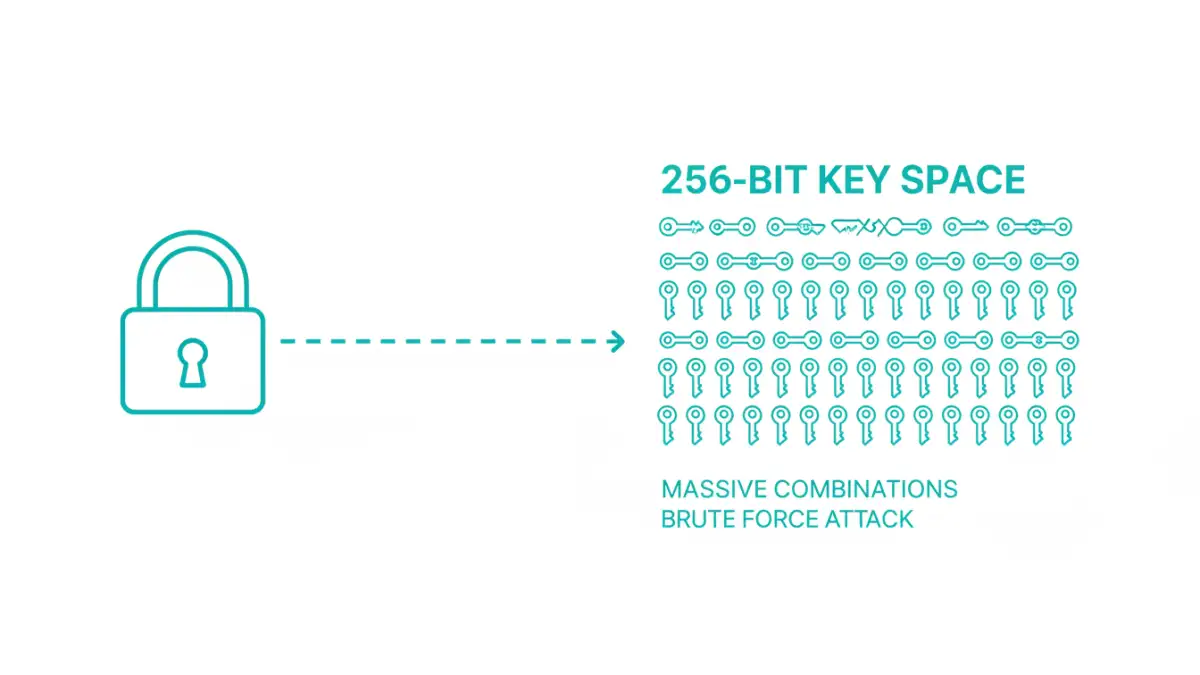
Think of an encryption key as a secret password for your data. When you encrypt a document, an algorithm uses this key to systematically scramble the information into an unreadable format called ciphertext. The only way to unscramble it back into a readable document is to use the exact same key.
In technical terms, a key is just a long string of binary digits (bits)—ones and zeros. The algorithm uses the unique pattern of these bits to perform its mathematical operations. Without the correct key, the ciphertext is just a meaningless jumble of data.
Understanding Cryptographic Key Size
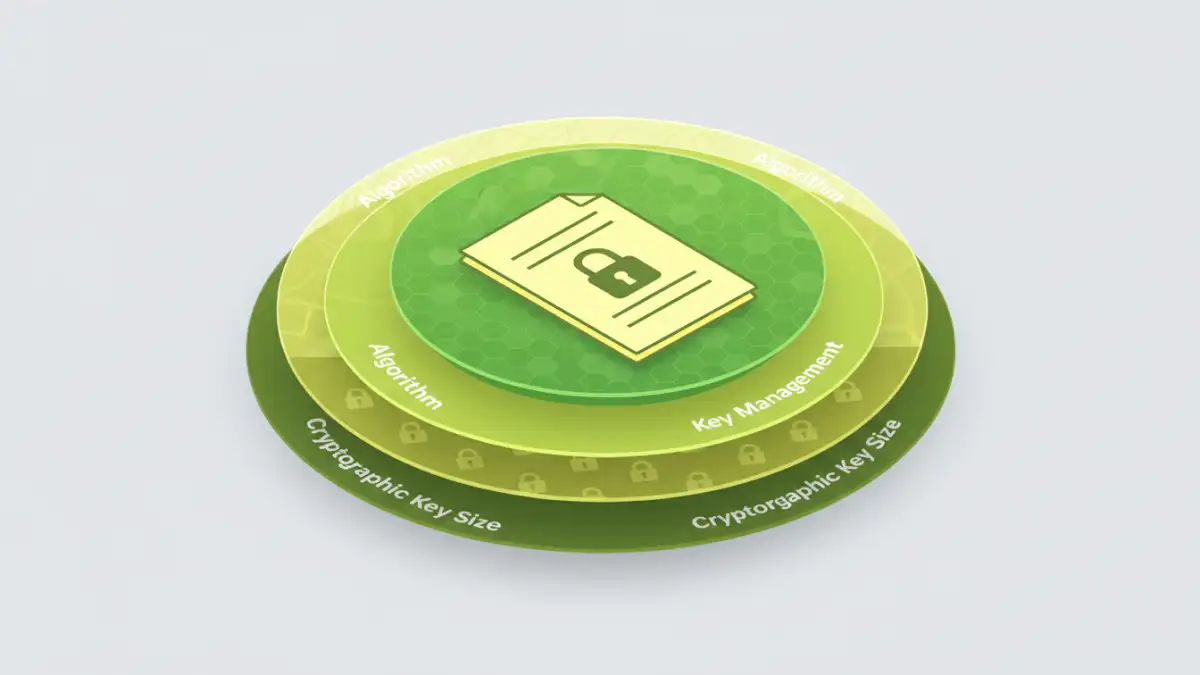
The "bit length" you see—like 128 or 256—refers to the number of bits in the key. A 128-bit key is a string of 128 ones and zeros. This length is crucial because it determines the total number of possible key combinations an attacker would have to guess to break the encryption.
How Key Length Creates Possibilities
The relationship between key length and the number of possible keys is exponential. Let's break it down:
- A 1-bit key has 2^1 (2) possible combinations: 0 or 1.
- A 2-bit key has 2^2 (4) possible combinations: 00, 01, 10, or 11.
- An 8-bit key has 2^8 (256) possible combinations.
Now, when we get to modern standards, the numbers become astronomically large. A 128-bit key has 2^128 possible combinations. That's a number with 39 digits. It's so large that it's difficult to even comprehend.
The Link to Brute Force Attack Protection
This massive number of possibilities is the foundation of modern brute force attack protection. A brute force attack is essentially a guessing game where an attacker tries every single possible key until they find the right one. With a large cryptographic key size, this becomes computationally impossible.
Even with the world's most powerful supercomputers working together, it would take billions of years to try every combination for a 128-bit key. This is why a sufficiently long key provides such robust security; it makes the cost and time required to break it completely impractical.
Common Key Lengths: AES 128 vs 256 bit
When you encounter encryption options, you'll most often see choices related to the Advanced Encryption Standard (AES). AES is a symmetric encryption algorithm adopted by the U.S. government and now used worldwide. It commonly comes in 128-bit, 192-bit, and 256-bit variants.
The debate often centers on AES 128 vs 256 bit. For years, I've seen teams deliberate over which to implement. The truth is, for almost all commercial and personal applications today, AES-128 is considered secure and is not known to have any practical vulnerabilities. It offers fantastic file protection strength.
AES-256, however, provides an even larger security margin. A 256-bit key has 2^256 possible combinations—a number so vast it's larger than the estimated number of atoms in the known universe. This level of security is required for TOP SECRET government files and is often chosen by organizations that want to ensure their data remains secure against theoretical future threats, including the potential advent of quantum computing.
How Key Length Impacts Your Document Security
Ultimately, the key length you choose has a direct impact on your document security encryption strategy. A longer key makes your data exponentially more difficult to crack through brute force. While a 256-bit key is technically more secure than a 128-bit key, the practical difference for today's technology is largely academic.
For most of us, the choice depends on the sensitivity of the data:
- Personal Use: Encrypting personal financial records, tax documents, or private correspondence? AES-128 offers more than enough protection.
- Business and Enterprise Use: Protecting sensitive corporate intellectual property, client data, or trade secrets? AES-256 is the gold standard. It provides peace of mind and demonstrates a commitment to the highest level of security.
It's also important to remember that key length is just one piece of the puzzle. The strength of the encryption algorithm itself (AES is very strong) and secure key management practices are equally vital. A 256-bit key won't help you if you write the password on a sticky note attached to your monitor.
Key Length Security Comparison
| Key Length | Number of Possible Combinations | Security Level | Common Use Case |
|---|---|---|---|
| 128-bit AES | 2^128 (approx. 3.4 x 10^38) | High (Sufficient for most uses) | General file protection, commercial applications, online banking. |
| 192-bit AES | 2^192 (approx. 6.2 x 10^57) | Very High | Used where higher security than 128-bit is mandated. |
| 256-bit AES | 2^256 (approx. 1.1 x 10^77) | Extremely High (Top Secret Standard) | Government classified data, high-value corporate assets, long-term data archiving. |