
Encountering challenges when trying to share sensitive documents securely within your application can be a significant hurdle. Ensuring that files are protected from unauthorized access, managed efficiently, and shared seamlessly is paramount for user trust and data integrity. Over my years working on various software projects, I've seen firsthand how crucial a well-implemented document sharing solution is.
This is where leveraging a robust secure document sharing API becomes indispensable. It allows developers to embed advanced security features and sharing functionalities directly into their own applications, providing a streamlined and protected experience for end-users. This guide will walk you through the process of integrating such an API, covering the essential steps and considerations.
Table of Contents
Understanding Secure Document Sharing APIs
A secure document sharing API acts as an intermediary, enabling your application to securely upload, store, retrieve, and share documents without building the entire infrastructure from scratch. These APIs typically handle complex security protocols, encryption, access controls, and audit trails, offering a pre-built, reliable solution. This approach significantly reduces development time and ensures a high level of security.
Core Functionalities
At their core, these APIs provide functionalities like secure file uploads, generating secure download links, managing user permissions, version control, and sometimes even built-in document preview capabilities. They are designed to be integrated into existing workflows, making them versatile for various applications, from collaboration tools to enterprise content management systems.
Choosing the Right API

Selecting the appropriate secure document sharing API depends on your specific needs. Factors to consider include the level of security required (e.g., end-to-end encryption), integration complexity, scalability, pricing, and available features. Some APIs offer extensive customization, while others provide a more straightforward, plug-and-play experience.
Evaluating API Providers
When evaluating API providers, look for clear documentation, robust support, and a proven track record in security. It's also wise to review their compliance certifications (like SOC 2, ISO 27001) if your application handles highly sensitive data. A good API provider will make the developer guide readily accessible and provide ample resources for integration.
API Integration: Step-by-Step
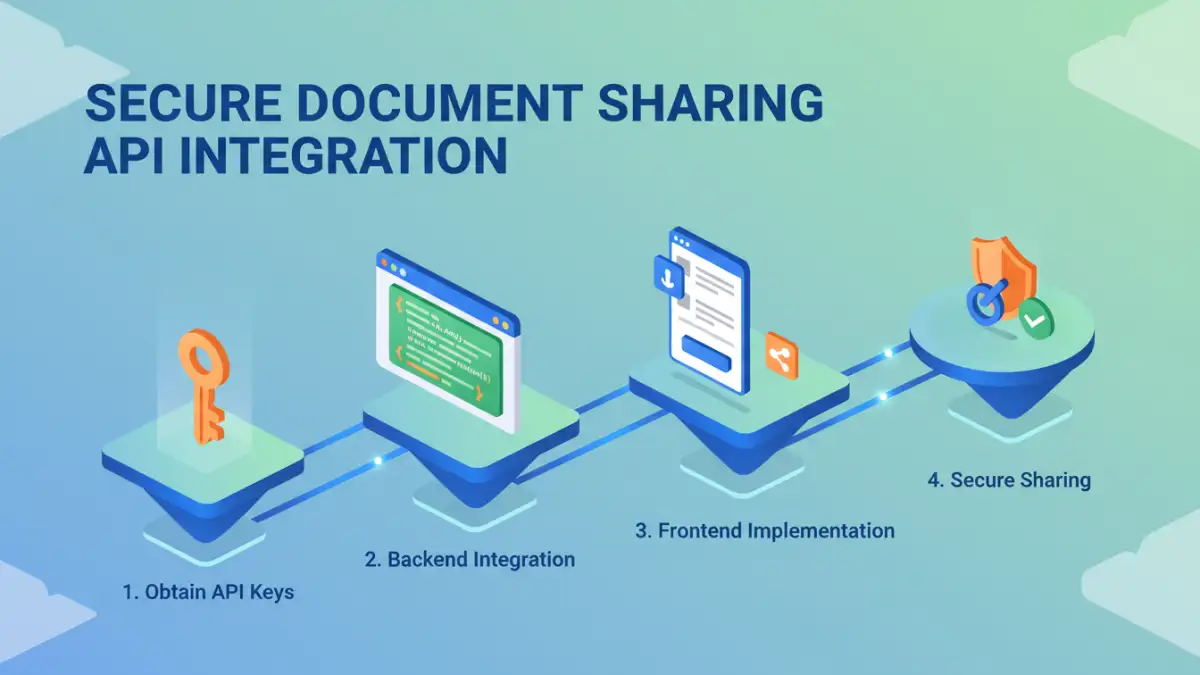
The integration process generally involves several key steps. First, you'll need to sign up with an API provider and obtain your API keys or credentials. This is your authentication token to access their services.
Next, you'll integrate the API calls into your application's backend. This usually involves making HTTP requests to the API endpoints for actions like uploading a file. You'll define how your application handles file uploads, associating them with users and relevant metadata. Finally, you'll implement the logic for generating secure sharing links or granting access to specific users within your application's frontend.
Example Workflow
A typical workflow might look like this: A user selects a file in your app, your backend sends it to the API endpoint for secure upload, the API returns a file ID. Your app then uses this ID to request a secure download link or to set permissions for other users. This entire process is managed by the API, abstracting away the complexities of secure file sharing.
Key Security Considerations
Security is paramount when dealing with document sharing. Ensure that the API you choose supports robust encryption, both in transit (TLS/SSL) and at rest. Implement proper authentication and authorization mechanisms on your end to control who can access the API and the documents.
Regularly review access logs and audit trails provided by the API to monitor activity and detect any suspicious behavior. It's also good practice to implement rate limiting on your API calls to prevent abuse and manage resource usage effectively. A well-thought-out secure file sharing strategy is crucial.
Leveraging Advanced Features
Beyond basic sharing, many APIs offer advanced features such as granular access controls (e.g., view-only, edit permissions), watermarking for sensitive documents, expiration dates for shared links, and comprehensive audit trails. Exploring these features can significantly enhance your application's capabilities and security posture.
Consider integrating features like document versioning, which allows users to track changes and revert to previous versions if needed. Some APIs also offer integration with e-signature solutions, further streamlining document workflows. These advanced capabilities can provide a competitive edge and greater value to your users.
Comparison Table
| API Type | Pros | Cons | Ideal Use Case |
|---|---|---|---|
| Cloud Storage API (e.g., S3, Google Cloud Storage) | Highly scalable, cost-effective, robust infrastructure | Requires custom security implementation, more development effort | Applications needing massive storage and custom security controls |
| Dedicated Document Sharing API (e.g., DocuSign, Box API) | Built-in security, compliance, advanced features (e-signatures, workflows) | Can be more expensive, less flexibility in core storage | Enterprise solutions, workflow automation, strict compliance needs |
| Self-Hosted Solution | Full control over data and security | High infrastructure costs, requires expert maintenance and security updates | Organizations with extreme data sovereignty requirements |