
I remember a project early in my career where we needed a quick way to encrypt user-uploaded configuration files. A quick search led me to a programming forum with a slick, compact script that seemed perfect. It was a tempting shortcut, and many developers fall into this trap. The question is, can you really trust that code with sensitive data?
The convenience of finding a ready-made solution is undeniable. But when it comes to security, convenience can be a dangerous lure. Relying on unvetted code from anonymous sources introduces significant risks that can compromise your entire application and your users' data.
Table of Contents
The Appeal of Forum Code: Why We Use It
Developers, especially when facing tight deadlines, often turn to community forums like Stack Overflow or Reddit for quick solutions. You find a thread where someone has the exact same problem, and another user has posted a complete code snippet that works. It feels like a collaborative victory.
This approach embodies the spirit of open problem-solving. It saves time, offers a direct solution without wading through dense documentation, and provides a starting point for a custom implementation. The problem is that code for a simple task, like sorting a list, has much lower stakes than code responsible for encryption.
Hidden Dangers in Plain Sight
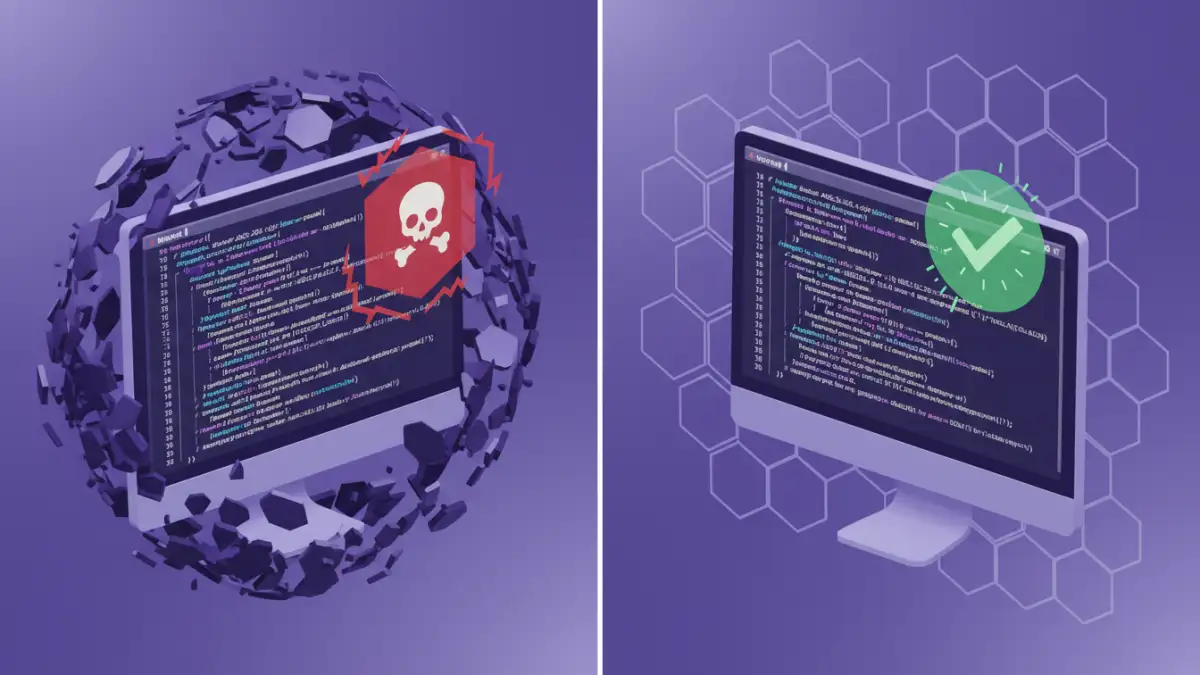
Copying and pasting security-critical code without scrutiny is like finding a key on the street and using it on your front door. It might work, but you have no idea who else has a copy. The risks associated with forum-sourced file encryption scripts are substantial.
Weak or Deprecated Cryptography
Many scripts found online use outdated or fundamentally flawed cryptographic algorithms. An algorithm like DES or MD5 might have been strong decades ago, but today they are easily broken. A well-meaning but uninformed author might post a script that functions but offers no real security against a determined attacker.
Intentional Backdoors and Malware
This is the most sinister risk. An attacker could intentionally post a helpful-looking encryption script that contains a hidden backdoor. This backdoor might exfiltrate the unencrypted data or the encryption keys to a remote server. The code could also contain other malware designed to compromise the system it runs on. These malicious parts are often obfuscated to avoid casual detection.
Poor Implementation and Subtle Flaws
Cryptography is notoriously difficult to implement correctly. Even if a script uses a strong algorithm like AES, it can be rendered useless by a poor implementation. Common mistakes include using hardcoded keys, improper initialization vector (IV) management, or susceptibility to padding oracle attacks. These are subtle flaws that only a security expert might notice.
How to Properly Vet Custom Security Scripts
If you absolutely must consider using a script from a forum, you cannot treat it as a black box. Proper due diligence is non-negotiable. This is where a deep understanding of secure coding practices becomes essential for what is effectively a DIY file encryption project.
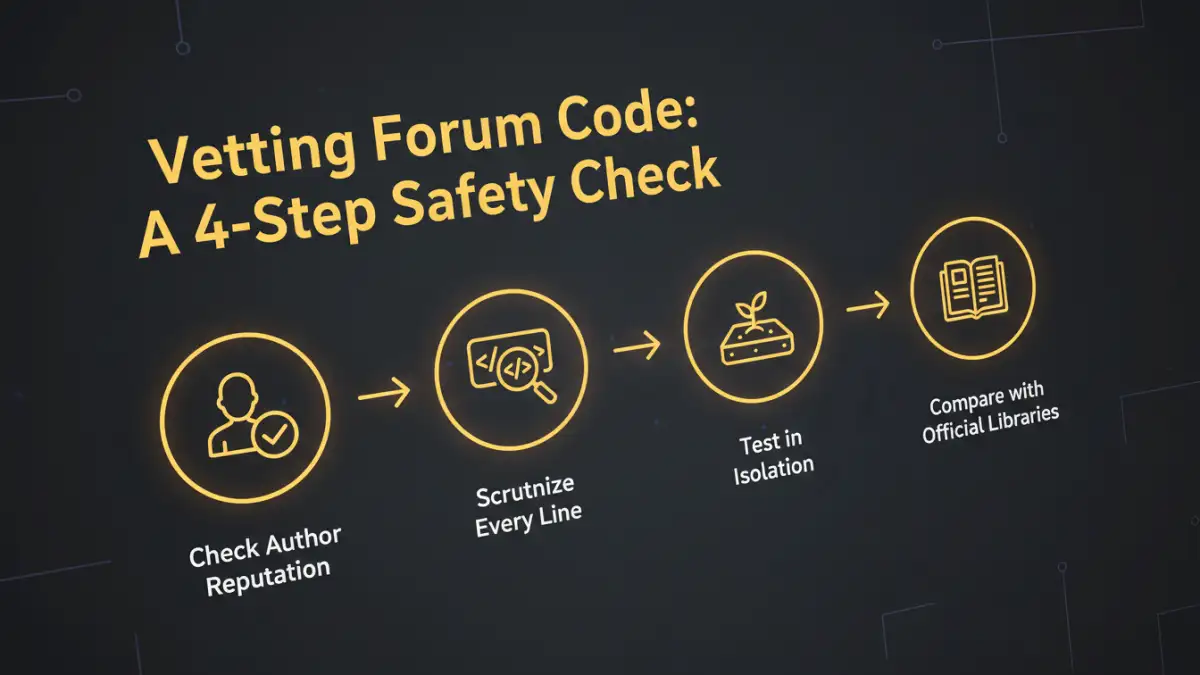
Analyze the Author and Community Feedback
Who posted the code? Do they have a reputable profile with a history of solid contributions? Check the comments and replies. Have other experienced developers reviewed it, pointed out flaws, or endorsed it? A script with zero feedback is a major red flag.
Conduct a Thorough Code Review
You must read and understand every single line of the script. Look for red flags such as network requests to unknown domains, file system operations that seem unnecessary, or strangely encoded strings. If you don't understand what a piece of the code does, you cannot trust it. This is a core principle of forum code safety.
Test in an Isolated Sandbox
Before ever running the script in a development or production environment, execute it in a completely isolated sandbox. Monitor its network activity, file access, and process creation. This can help you spot malicious behavior, like the script trying to "phone home" to an attacker's server.
Safer Alternatives for Reliable Encryption
Frankly, the risks of using forum scripts for encryption usually outweigh the benefits. The good news is that you don't need to. Secure, well-vetted alternatives are readily available and are almost always the better choice.
Instead of searching forums, turn to established, peer-reviewed cryptographic libraries for your programming language. For Python, this means libraries like `cryptography`. For Java, you have the built-in `JCE` (Java Cryptography Extension). These libraries are maintained by experts, scrutinized by the security community, and designed to prevent common implementation mistakes. This is the gold standard for open source encryption.
Additionally, consider using trusted command-line tools like GnuPG or the encryption features built into your operating system, such as BitLocker (Windows) or FileVault (macOS). These tools are robust, heavily tested, and do not require you to write any cryptographic code yourself, eliminating the risk of implementation errors.
Source Comparison for Encryption Code
| Code Source | Security Risk | Ease of Use | Reliability & Maintenance |
|---|---|---|---|
| Community Forums | Very High | High (Copy/Paste) | None |
| GitHub Gists | High | High (Copy/Paste) | Very Low |
| Official Crypto Libraries | Very Low | Medium (Requires Reading Docs) | High (Actively Maintained) |
| Operating System Tools | Very Low | Low (Requires System Knowledge) | High (Maintained by OS Vendor) |
| Commercial SDKs | Low | High (Good Documentation) | High (Vendor Support) |