
Working with password-protected documents can be frustrating, especially when you've forgotten the password or inherited a file without one. This is particularly true for OpenDocument files, a common format for office suites like LibreOffice and OpenOffice. Losing access to critical spreadsheets, documents, or presentations can halt productivity. Fortunately, there are methods to address this, ranging from simple workarounds to more technical solutions. My experience has shown that understanding these options is key to recovering your data efficiently.
Table of Contents
Understanding OpenDocument Security
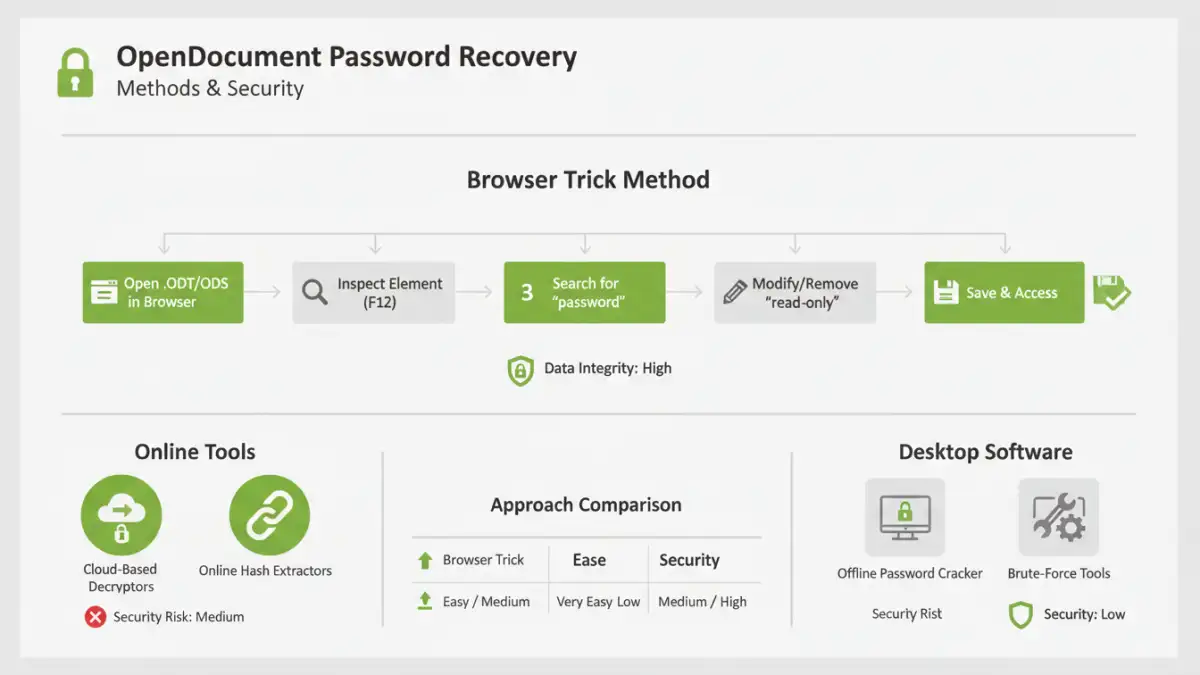
OpenDocument files (.odt for text documents, .ods for spreadsheets, .odp for presentations) can be protected with passwords to prevent unauthorized access or modification. This security feature is built into the OpenDocument standard, offering a layer of privacy for your sensitive information. The strength of this protection can vary depending on the encryption method used by the specific application.
How Passwords Work
When you set a password on an OpenDocument file, the application encrypts the file's content. Only by providing the correct password can the application decrypt and display the file's contents. If the password is lost or unknown, direct access to the data within the file becomes impossible without employing specific recovery techniques.
Basic Recovery Methods

Before diving into complex solutions, there are a few simpler methods that might work, especially if the password protection isn't exceptionally strong or if you suspect a simple oversight.
The Browser Trick (for some ODT files)
For password-protected ODT files, there's a well-known workaround that involves treating the file as a ZIP archive. Some versions of LibreOffice and OpenOffice encrypt ODT files in a way that this method can bypass. You can try renaming the .odt file extension to .zip, then opening it with a standard ZIP utility. Inside, you'll find an XML file (usually named 'content.xml'). You can then edit this XML file to remove the password-related tags, save it, and rename the .zip file back to .odt. This method is not foolproof and primarily works for older or less robust encryption methods.
Online OpenDocument Password Removal Tools
Several online services claim to offer open document password removal. These tools typically require you to upload your password-protected file, and they attempt to decrypt it on their server. While convenient and often free for basic use, it's crucial to be cautious about uploading sensitive documents to third-party websites due to potential privacy and security risks. Always research the reputation of any online tool before use.
Advanced OpenDocument Password Recovery
When basic methods fail, more advanced techniques might be necessary. These often involve specialized software or brute-force approaches.
Desktop Software Solutions
Dedicated desktop software exists for recovering or removing passwords from various file types, including OpenDocument formats. These tools often employ brute-force attacks, dictionary attacks, or known-plaintext attacks to guess the password. For example, tools might be available for ods password recovery or odp password crack scenarios. Such software can be powerful but may require a purchase and can take a significant amount of time, depending on the password's complexity and the software's efficiency.
Understanding Encryption Strength
It's important to note that modern versions of office suites often use stronger encryption algorithms. This makes brute-force attacks significantly more time-consuming and less likely to succeed, especially for complex passwords. If a file was encrypted with a strong password using robust encryption, recovery might become practically impossible without knowing the password.
Prevention and Best Practices
The best approach to dealing with lost passwords is to prevent the situation from occurring in the first place. Implementing strong security habits can save a lot of trouble down the line.
Use Password Managers
For important documents, consider using a reliable password manager. These tools can generate strong, unique passwords and store them securely, making it easy to retrieve them when needed. This is far more secure and practical than trying to remember multiple complex passwords.
Backup Regularly
Always maintain regular backups of your important files. If you encounter issues with a password-protected file, having a backup copy that is not password-protected (or has a password you know) can be a lifesaver. Ensure your backup strategy includes different locations, such as external drives or cloud storage.
Comparison Table: OpenDocument Password Recovery Methods
| Method | Pros | Cons | Best For |
|---|---|---|---|
| Browser Trick (.odt) | Free, no extra software needed | Only works for specific ODT encryption, not guaranteed | Quick attempt for simple ODT password bypass |
| Online Tools | Convenient, accessible from anywhere, often free for basic use | Privacy/security concerns, limited features, not always effective | Non-sensitive documents, quick attempts |
| Desktop Software | Powerful, can handle various password types (ODS, ODP) | Often requires purchase, can be time-consuming, may require technical knowledge | Complex recovery scenarios, sensitive files (use trusted software) |
| Password Managers | Secure password generation and storage, prevents loss | Requires initial setup, potential subscription costs | Long-term prevention of password loss |