When dealing with digital assets that have been around for a while, you might encounter older image formats that hold significant value, whether personal memories or critical business data. The challenge often arises when you need to ensure the security and privacy of these files, especially if they contain sensitive information. Protecting these older files requires understanding how to apply modern security principles, including robust encryption, to formats that might not have been designed with today's threats in mind.
My work has frequently involved migrating and securing data from various sources, and I've seen firsthand how crucial it is to safeguard even seemingly simple files like images. It's not just about preventing unauthorized access; it's also about maintaining data integrity and ensuring that your precious memories or important documents remain private and secure over time.
Table of Contents
Why Encrypt Legacy Image Files?
The primary reason for encrypting any digital file, including legacy image files, is to protect sensitive information from unauthorized access. Think about personal photos containing identifiable details, or historical documents scanned into image formats. Without encryption, anyone who gains access to the file could view its contents. This is particularly important if you're storing these files on cloud services, external drives, or sharing them online.
Furthermore, encryption adds a layer of integrity. While not its primary function, certain encryption methods can help detect if a file has been tampered with. This ensures that your images remain exactly as you intended them to be, safeguarding against accidental or malicious alterations.
Protecting Privacy
Privacy is paramount, especially with personal photographs or confidential business records. Encrypting these files ensures that only individuals with the correct decryption key or password can access them. This is crucial for complying with data protection regulations and maintaining personal privacy.
Common Legacy Image Formats
Over the years, various image formats have been popular, some of which are now considered legacy. Understanding these formats is the first step in knowing what you need to protect. Each format has its own characteristics and potential vulnerabilities.
TIFF and JPEG
TIFF (Tagged Image File Format) is a common format for high-quality, lossless images, often used in professional printing and archiving. Its flexibility means it can store a lot of metadata, but it can also result in large file sizes. JPG (or JPEG) is a widely used lossy compression format known for its smaller file sizes, making it ideal for web use and general photography. While JPG is ubiquitous, its lossy nature means some quality is sacrificed for size.
Other Older Formats
Beyond TIFF and JPG, other formats like BMP (Bitmap), GIF (Graphics Interchange Format), and even older proprietary formats might be encountered. BMP files are uncompressed and can be very large. GIF, while supporting animation, is limited in color depth. Each of these has different compression schemes and data structures, which can influence how easily they can be encrypted or how secure they are.
Encryption Methods for Images
Applying encryption to image files, especially older formats, involves using software or tools that can either encrypt the entire file container or embed encryption within the file's metadata or structure, though the former is far more common and practical. The goal is to make the image unreadable without the correct decryption key.
File-Level Encryption
The most straightforward approach is file-level encryption. This treats the image file as any other document. You use encryption software (like VeraCrypt, BitLocker, or even built-in OS features) to create an encrypted archive or container, or to encrypt the entire drive or folder where the images are stored. When you need to access an image, you decrypt the file or container first. This method is robust and works with virtually any file type, including legacy image files.
Password Protection (Limited)
Some specific image viewers or editing software might offer password protection features for certain image formats. However, this is less common for standard formats like JPG or TIFF and more likely found in specialized archival or proprietary software. These methods can sometimes be less secure or proprietary, meaning you're locked into using specific software for decryption.
Using Archiving Tools
Another effective method is to use archiving tools like 7-Zip or WinRAR. You can add your image files to a password-protected archive. These tools use strong encryption algorithms (like AES-256) to secure the archive. This is a very practical way to bundle multiple images and protect them with a single password, ensuring image file security.
Practical Steps to Encrypt
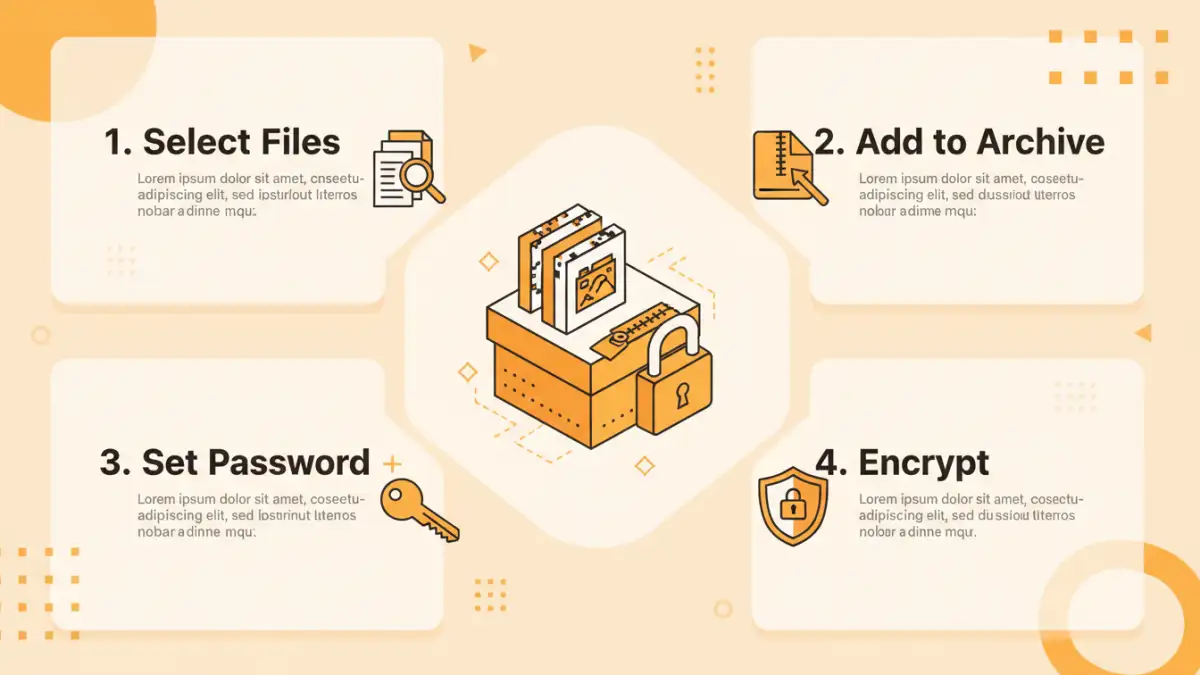
Let's walk through a common and effective method: using a file archiving tool with strong encryption. We'll use 7-Zip as an example, as it's free, open-source, and supports robust encryption.
Step 1: Download and Install 7-Zip
If you don't already have it, download 7-Zip from its official website and install it on your computer. It's available for Windows, and similar tools exist for macOS and Linux.
Step 2: Create a Password-Protected Archive
Right-click on the image file(s) or the folder containing them. In the context menu, select '7-Zip' and then 'Add to archive...'. In the 'Add to Archive' dialog box, choose an archive format (e.g., .7z or .zip). Crucially, enter a strong password in the 'Enter password' and 'Reenter password' fields. You can also choose the encryption method; AES-256 is recommended for strong security.
Step 3: Encrypt and Save
Click 'OK'. 7-Zip will create a new archive file (e.g., 'my_images.7z'). This archive file is now encrypted. To access the images inside, you will need to open the archive using 7-Zip and enter the password you set.
Step 4: Securely Delete Originals (Optional but Recommended)
Once you have confirmed that the encrypted archive is created successfully and you can extract the files using the password, you may want to securely delete the original image files to ensure no unencrypted copies remain.
Best Practices for Image File Security
Beyond just encrypting your files, several practices enhance the overall security of your legacy image files. Thinking holistically about protection is key to long-term data safety.
Use Strong, Unique Passwords
The strength of your encryption is only as good as your password. Use a long, complex password that combines uppercase and lowercase letters, numbers, and symbols. Avoid using easily guessable information like birthdays or names. Consider using a password manager to generate and store strong, unique passwords for your encrypted archives.
Regular Backups
Encryption protects against unauthorized access, but it doesn't protect against data loss due to hardware failure, accidental deletion, or natural disasters. Maintain regular backups of your encrypted image files on separate storage media or cloud services. Ensure your backup strategy is also secure.
Keep Software Updated
Ensure that your operating system, encryption software, and archiving tools are always up to date. Software updates often include security patches that fix vulnerabilities discovered in previous versions. This is a critical step in maintaining robust photo protection.
Comparison Table: Encryption Methods for Image Files
| Method | Pros | Cons | Best For |
|---|---|---|---|
| File-Level Encryption (e.g., VeraCrypt, BitLocker) | Very strong security, works with any file type, versatile (full disk, container, folder) | Can be complex to set up, requires decryption/re-encryption for access | Sensitive collections, entire drives |
| Password-Protected Archives (e.g., 7-Zip, WinRAR) | Easy to use, bundles multiple files, strong encryption algorithms (AES-256) | Requires archive software to open, password must be remembered or managed | Bundling and protecting multiple images, occasional access |
| Built-in OS Encryption (e.g., EFS on Windows) | Integrated into the OS, seamless for users | May be less robust than dedicated tools, platform-dependent | Basic user-level protection on personal computers |
| Cloud Storage Encryption (Built-in) | Automatic encryption during upload/transit, accessible from anywhere | Relies on provider's security, potential privacy concerns with provider access | Convenient access across devices, general file storage |